 Hilton Pond Center for Piedmont Natural History near York, South Carolina, lies just 15 straight-line miles from the Catawba River, so it seems likely our property was traversed in times past by Catawba Indians exploring its tributaries. Although this is pure speculation, there can be no doubt about the tribe's connection with the actual waterway, for the Catawbas call themselves yeh is-WAH h'reh, or "People of the River." Since overflow from Hilton Pond makes its way into Fishing Creek and eventually the Catawba River, we feel a natural affinity for the Catawba Indian Nation past and present. Hilton Pond Center for Piedmont Natural History near York, South Carolina, lies just 15 straight-line miles from the Catawba River, so it seems likely our property was traversed in times past by Catawba Indians exploring its tributaries. Although this is pure speculation, there can be no doubt about the tribe's connection with the actual waterway, for the Catawbas call themselves yeh is-WAH h'reh, or "People of the River." Since overflow from Hilton Pond makes its way into Fishing Creek and eventually the Catawba River, we feel a natural affinity for the Catawba Indian Nation past and present.
The Catawbas settled on the banks of the Catawba River--primarily in what is now York County, South Carolina--and built permanent, bark-covered roundhouses in which to live, plus huge Council Houses for tribal meetings. They hunted Piedmont woodlands and prairies and fished in the river and its feeder streams. 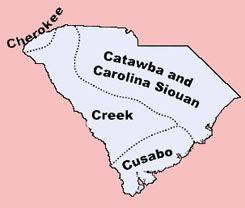 They also farmed and planted corn extensively in rich river bottomlands. Once a large and powerful group numbering tens of thousands, they waged ongoing war with the Cherokees and tribes of the Ohio River Valley (see South Carolina map at left), being successful in battles with the former but not faring well against the Six Nations. Hernando de Soto, the Spanish explorer, made first contact with the Catawbas in 1540. When Europeans began settling in the Carolina Piedmont, the Catawbas remained friendly, but many succumbed over the years to "white man" diseases such as smallpox; by 1826 there were only about 110 true Catawbas left, some of whom moved elsewhere. They also farmed and planted corn extensively in rich river bottomlands. Once a large and powerful group numbering tens of thousands, they waged ongoing war with the Cherokees and tribes of the Ohio River Valley (see South Carolina map at left), being successful in battles with the former but not faring well against the Six Nations. Hernando de Soto, the Spanish explorer, made first contact with the Catawbas in 1540. When Europeans began settling in the Carolina Piedmont, the Catawbas remained friendly, but many succumbed over the years to "white man" diseases such as smallpox; by 1826 there were only about 110 true Catawbas left, some of whom moved elsewhere.
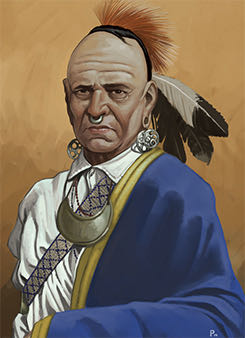 King Hagler, or Nopkehee (c. 1700–1763), was Catawba chief from 1754 to 1763. Known as the "patron saint of Camden, South Carolina" he was an important ally for colonists in that area. He negotiated the treaty of Pine Tree Hill in July 1760, providing a 15-square-mile Catawba reservation on the Carolinas border. On 30 August 1763, Hagler was ambushed and killed by seven Shawnees. His bust is a popular adornment for Catawba pottery (see examples below) and he was the first Native American to be inducted into the South Carolina Hall of Fame (stylized portrait at right). King Hagler, or Nopkehee (c. 1700–1763), was Catawba chief from 1754 to 1763. Known as the "patron saint of Camden, South Carolina" he was an important ally for colonists in that area. He negotiated the treaty of Pine Tree Hill in July 1760, providing a 15-square-mile Catawba reservation on the Carolinas border. On 30 August 1763, Hagler was ambushed and killed by seven Shawnees. His bust is a popular adornment for Catawba pottery (see examples below) and he was the first Native American to be inducted into the South Carolina Hall of Fame (stylized portrait at right).
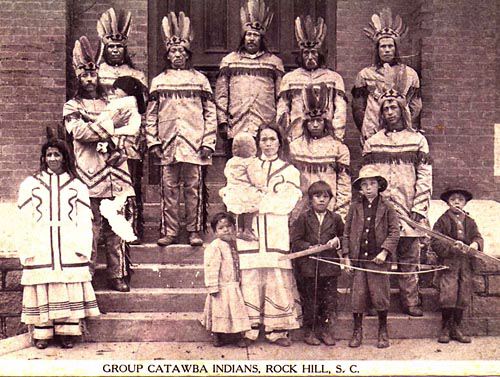
Catawba Indians at the Corn Expostion (Columbia SC, 1913)
In years since, the Catawba population has stabilized and grown with a resurgence of interest in Catawba heritage. Although there are no longer any full-blooded Catawbas, the tribe's cultural history has been retained by 2,000 or so descendants now living on or near the current reservation at Rock Hill SC. 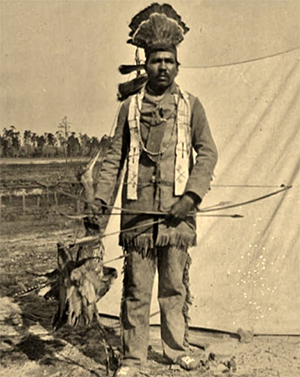 (Sallie Brown Gordon, the last native speaker of the Catawba language--a dialect of Eastern Siouxan--died in 1952.) The tribe is also interested in preserving and conserving natural aspects of the reservation, especially habitats along the Catawba River bottomland. (Sallie Brown Gordon, the last native speaker of the Catawba language--a dialect of Eastern Siouxan--died in 1952.) The tribe is also interested in preserving and conserving natural aspects of the reservation, especially habitats along the Catawba River bottomland.
(Unfortunately, disagreements among various factions of modern-day Catawbas have resulted in lack of unity within the tribe; the public often hears of this turmoil rather than the good work of many tribal members. The 2007 election of Donald Wayne Rodgers (below left) as chief--the tribe's first new leader in more than three decades--appeared to bode well for reconciliation; according to Rodgers, in late September 2010 a general vote was taken to remove him from office, but he was cleared of any wrongdoing and finished his term in July 2011. Under his stewardship the tribe was relieved of more than $13 million in debt owed the federal government. 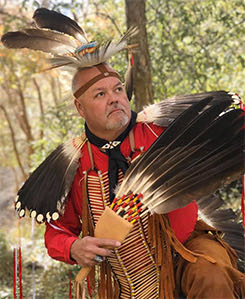 Rodgers reports he withdrew from further election in 2011 and was replaced by a new chief, Bill Harris, who is serving his third term and has announced his intention to retire in 2023.) Rodgers reports he withdrew from further election in 2011 and was replaced by a new chief, Bill Harris, who is serving his third term and has announced his intention to retire in 2023.)
(Ground was broken in 2020 at a site along I-85 just north of the SC/NC state line for the full-scale Two Kings Casino--named for Kings Mountain and King Hagler and to be operated by the Catawba Nation. A temporary facility with slot machines opened in July 2021, with plans for rapid expansion. Use an Internet search engine to get the latest info about the Catawbas, including work on the casino and how revenue from it will be used. You may also wish to visit their newly revised Web site at The Catawba Nation or their updated Facebook page.)
Historically, a male Catawba's typical ceremonial garb consisted of a long-sleeved leather coat with fringe; long trousers; and a distinctive headdress consisting of a head band with large, erect eagle feathers. Women wore a decorated coat, leggings, and a long skirt. (See photos of Benjamin P. Harris, above right; and, above that, a group of Catawbas at the S.C. Corn Exposition in 1913. Mr. Harris is holding a bow and arrows and, in his right hand, what appears to be a Great Blue Heron with an arrow through its body.) In modern times, some Catawba males elected to wear Plains Indians war bonnets and turquoise jewelry during appearances, unfortunately ignoring their heritage and propagating to students and the public the stereotype that all Indian tribes and nations dressed alike.
All text & photos © Hilton Pond Center; do not use or duplicate in any way
CATAWBA INDIAN POTTERS & POTTERY
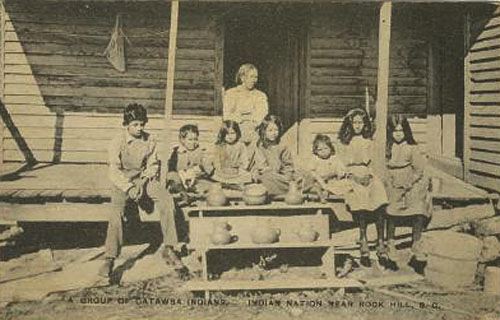
Perhaps the Catawba Indian Nation's greatest lasting legacy is its pottery, made in simple, elegant style that is instantly recognizable. Production and sale of pottery is not a "new" phenomenon, as indicated by a circa 1910 postcard (above) from the Indian Nation near Rock Hill SC depicting Catawba potter Sarah Jane Ayers Harris and seven grandchildren. (Note that everyone pictured is wearing "white man" clothing quite unlike traditional Catawba garb.) Catawbas sometimes sold their pottery from roadside stands for the "tourist trade" and in mid-20th century set up booths at the gates to Winthrop College in Rock Hill; there, coeds at the then-all-girls school could purchase items both functional and decorative. These pottery pieces went for as little as 25 cents each; some are now worth hundreds--even thousands--of dollars.
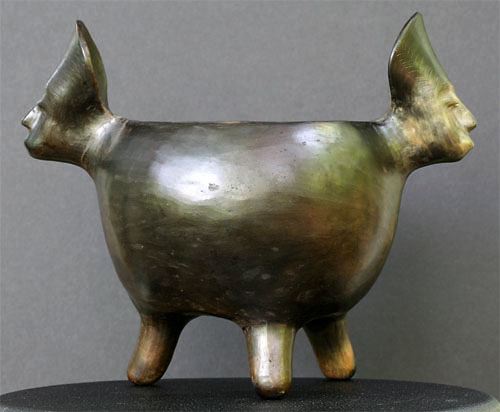
Large Chief's Head Pot
(11" x 9"; signed by Sara Ayers, undated; head detail below right)
All text & photos © Hilton Pond Center; do not use or duplicate in any way
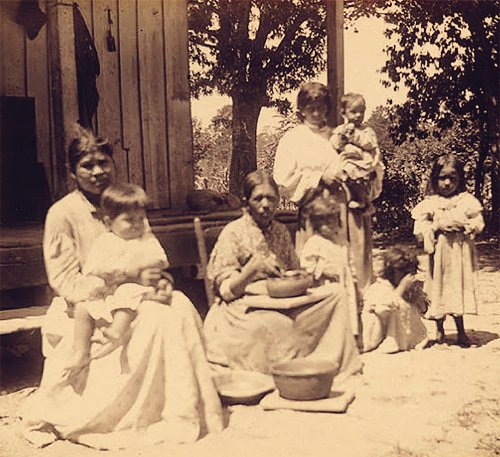
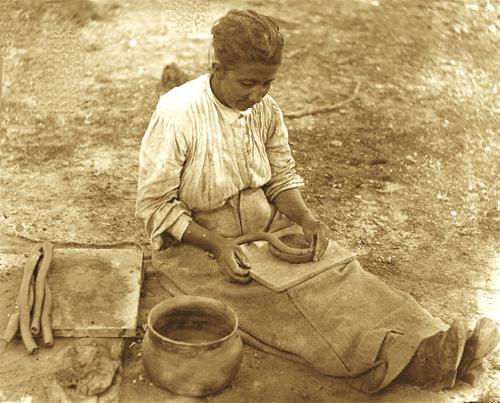
Catwba Potter, 1908
All text & photos © Hilton Pond Center; do not use or duplicate in any way
In his book on The Catawbas (1989), James H. Merrell states: "The Catawba women who continue to make pottery using the traditional techniques are an on-going link with the tribe's past. They ensure that Catawba pottery will remain the oldest art form still produced in South Carolina." Merrell has a nice description of how Catawba pots are made; it is paraphrased below.
All text & photos © Hilton Pond Center; do not use or duplicate in any way
Traditionally--and even today--Catawba men and children dig clay from isolated pits along the Catawba River; these prime sites are often kept secret from outsiders. 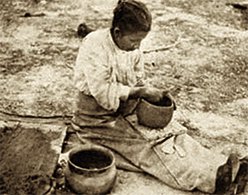 After cleaning and drying their clay, Catawba women grind it into very fine powder to eliminate gritiness from the final product. Water is added, and the mixture is worked to the proper consistency. After cleaning and drying their clay, Catawba women grind it into very fine powder to eliminate gritiness from the final product. Water is added, and the mixture is worked to the proper consistency.
Unlike many modern potters who "throw" pots on a wheel or mold pots free-hand, Catawbas still use lumps or snake-like coils of clay to form their pots (see 1913 photos just above and above left of Catawba potter Rachel Brown). After flattening a clay lump to make a pot's bottom, the potter joins the ends of her first clay coil and adds it to the base. 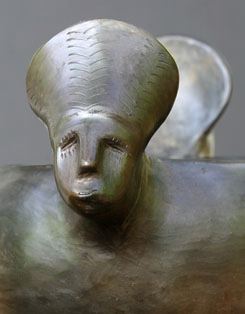 All joints are smoothed, a second coil is added atop the first, then a third, and so on until the desired height is reached. This so-called "green" pot is allowed to dry for a few days, after which the potter thins the walls and smooths inner and outer surfaces using tools that may have been passed down from her/his mother or grandma or great granny. These smoothing implements--made of bone, shell, wood, or metal--are among the potter's most cherished possessions. All joints are smoothed, a second coil is added atop the first, then a third, and so on until the desired height is reached. This so-called "green" pot is allowed to dry for a few days, after which the potter thins the walls and smooths inner and outer surfaces using tools that may have been passed down from her/his mother or grandma or great granny. These smoothing implements--made of bone, shell, wood, or metal--are among the potter's most cherished possessions.
A final dampening of the pot allows the potter to polish it to a glass-like finish. Ornamentation may be added in the form of handles, spouts, or the head of ancient Chief Hagler, AKA Nopkehe (see two photos of a chief's head pot above).
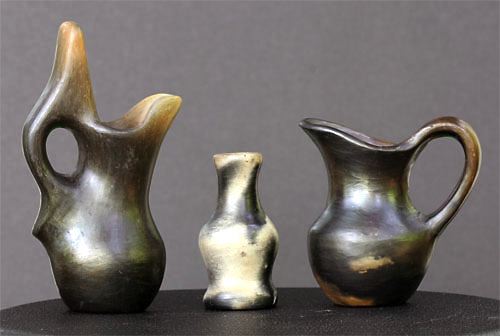
Two Small Pitchers and a Small Vase
(Left: 6.5" x 3.5"; Rebecca pitcher; signed by Viola Robbins, 1995)
(Center: 3.5" x 1.75"; vase; unsigned & undated)
(Right: 4.25" x 4"; pitcher; signed by Sara Ayers, undated)
All text & photos © Hilton Pond Center; do not use or duplicate in any way
Catawba Indian pottery is NEVER painted, nor is it glazed--even though it often has a soothing sheen (above) that comes from the firing process; well-smoothed pieces by the most talented and meticulous potters have an even shinier apperance. Artistic incising sometimes is applied on the outer surface of the pot (see leaf inscription on small pot below left). Note that Catawba INDIAN pottery should not be confused with Catawba VALLEY pottery from North Carolina; the latter is NOT Native American artwork. Furthermore, what is represented as Catawba Indian pottery by sellers on eBay or other outlets sometimes isn't--an indication an unscrupulous seller may be trying to mislead potential buyers or, at best, simply hasn't done the proper research and makes unfounded or incorrect statements. Caveat emptor! (NOTE: Cherokee potters frequently use the same techniques employed by the Catawbas. For unsigned pieces it is sometimes impossible to tell the difference, although Cherokee pots are often darker, even black, with less mottling.)
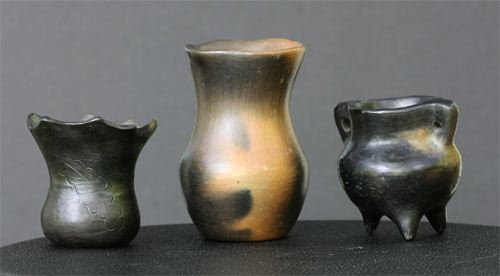
Three Small Containers
(Left: 2.75" x 2.5"; vase; incised and signed by
Warren B. Sanders, 5/13/1996)
(Center: 4" x 2.5"; vase; signed by Viola Robbins, 1995)
(Right: 2.75" x 3"; three-legged pot with handles;
unsigned & undated)
All text & photos © Hilton Pond Center; do not use or duplicate in any way
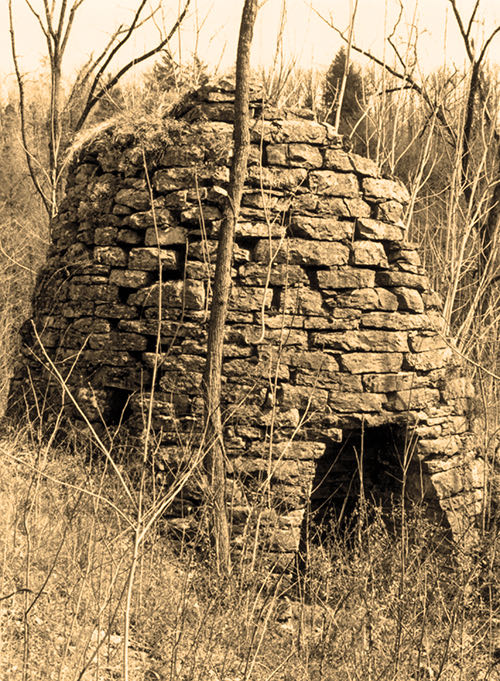
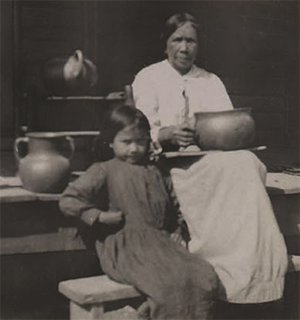 Most Catawba potters sun-dry their pots before firing them outdoors in a pit or open fireplace. (The photo below is reputed to be an outdoor furnace used by Catawbas to fire pottery.) Depending on the clay source and how and where wood is placed on or in a piece during the process, this yields a unique mottled pattern (see photo just above) of black, tan, orange, and/or brown that makes the smooth but unglazed final product so distinctive. (See photo above left of Catawba potter Sarah Harris, c. 1908.) This technique is believed to have been used by the Catawbas for up to 4,600 years and apparently pre-dates the work of more familiar pottery-making tribes in the Southwestern United States. Assuming this is true, Catawba pottery is likely the oldest North American art form in continuous use to the present day. Most Catawba potters sun-dry their pots before firing them outdoors in a pit or open fireplace. (The photo below is reputed to be an outdoor furnace used by Catawbas to fire pottery.) Depending on the clay source and how and where wood is placed on or in a piece during the process, this yields a unique mottled pattern (see photo just above) of black, tan, orange, and/or brown that makes the smooth but unglazed final product so distinctive. (See photo above left of Catawba potter Sarah Harris, c. 1908.) This technique is believed to have been used by the Catawbas for up to 4,600 years and apparently pre-dates the work of more familiar pottery-making tribes in the Southwestern United States. Assuming this is true, Catawba pottery is likely the oldest North American art form in continuous use to the present day.
All text & photos © Hilton Pond Center; do not use or duplicate in any way
All text & photos © Hilton Pond Center; do not use or duplicate in any way
THE POTTERS
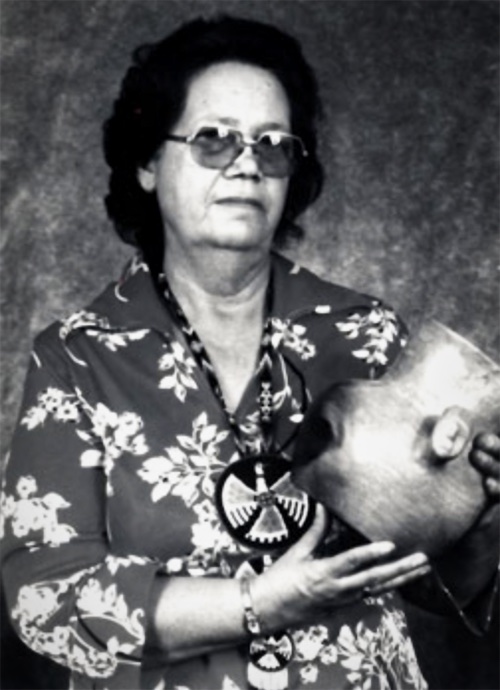
Perhaps the best-known Catawba potter in recent decades was Sara Ayers 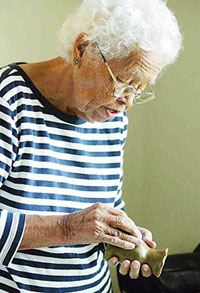 (1919-2002; above, with one of her signature pieces--a Chief Haigler pot), whose exemplary signed art is some of the most avidly sought by collectors. She was taught--as were many of the potters of her generation and the two that followed--by Arzada Sanders (1896-1989). Even earlier among the master artisans was Martha Jane Harris (1860-1936), grandmother of master potter Georgia Harris (1905-1997) who in 1997 received the National Heritage Fellowship Award from the National Endowment for the Arts. (1919-2002; above, with one of her signature pieces--a Chief Haigler pot), whose exemplary signed art is some of the most avidly sought by collectors. She was taught--as were many of the potters of her generation and the two that followed--by Arzada Sanders (1896-1989). Even earlier among the master artisans was Martha Jane Harris (1860-1936), grandmother of master potter Georgia Harris (1905-1997) who in 1997 received the National Heritage Fellowship Award from the National Endowment for the Arts.
Among the more creative and accomplished of recent-era Catawba potters were the following: Evelyn Brown George (1914-2007, above left); Mildred Blue (1922-1997, first Catawba to graduate from Rock Hill High School); Emma Harris Canty Brown (1889-1961)--wife of Van Wyck SC ferryman Early Morgan Brown (1891-1963), who assisted Emma in scraping pottery pieces; Florence Harris Garcia Wade (1922-2017); Nola Campbell (1918-2009); Catherine Sanders Canty (1917-1999); 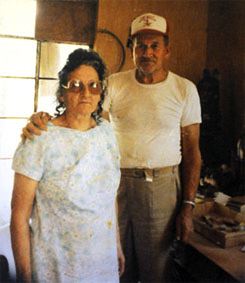 Alberta Canty Ferrell (1929-1998), Doris Blue (1905-1985); and Reola Harris (1921-1991)--twin sister to Viola Harris Robbins (1922-2010), in photo below right with husband Earl Robbins (1922-2010). Alberta Canty Ferrell (1929-1998), Doris Blue (1905-1985); and Reola Harris (1921-1991)--twin sister to Viola Harris Robbins (1922-2010), in photo below right with husband Earl Robbins (1922-2010).
Earl Robbins, son of Frank Robbins and Effie Harris Robbins, was undoubtedly the most famous and productive of all the male Catawba potters; he was especially known for his creative "oversized" pieces, including figurals. He also specialized in making pipe molds sought after by other Catawbas wishing to make pipes. See his very unusual "horse bowl" design (below). Earl died of Alzheimer's disease in March 2010, just two months after his wife Viola. They were married 68 years.
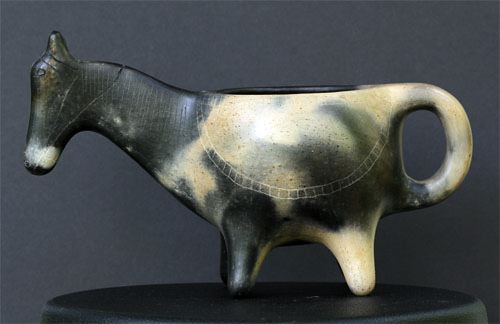
Large Horse Bowl
(12" x 6"; signed by Earl Robbins, 1990. The horse's neck
is not broken; the line represents reins.
All text & photos © Hilton Pond Center; do not use or duplicate in any way
Virtually all the tribe's mid-20th century master potters have passed on, with Margaret Robbins Tucker (photo below left; b. 1957, daughter of Earl and Viola) perhaps the last notable one still making pottery. Fortunately, the clay-working tradition of the Catawba Indian Nation is being continued by a new generation of artisans, 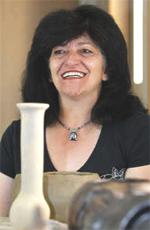 many of whom are children or grandchildren of the folks listed above. Some are on their way to becoming Native American master potters in their own right. many of whom are children or grandchildren of the folks listed above. Some are on their way to becoming Native American master potters in their own right.
This "new generation" of indigenous potters includes, among others, such Catawbas as Monty Hawk Branham, Keith Brown, Edwin Campbell, Donald Harris, Billie Anne McKellar, Della Oxendine, Elizabeth Plyler, Brian Sanders, Caroleen Sanders, Cheryl Harris Sanders, Freddie Sanders, Marcus Sanders, and Margaret Tucker. Several of these younger people produce traditional pottery, while others are exercising creativity in making original designs unknown to their ancestors--yet another indication the long-lasting legacy of Catawba Indian pottery-making is alive and well.
All text & photos © Hilton Pond Center; do not use or duplicate in any way
All text & photos © Hilton Pond Center; do not use or duplicate in any way
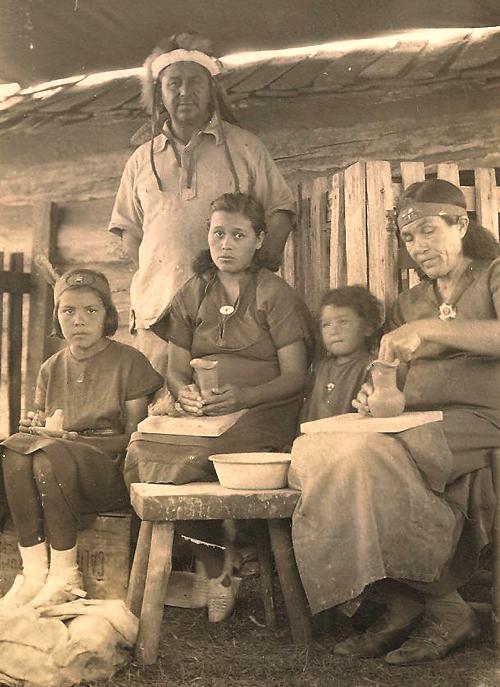
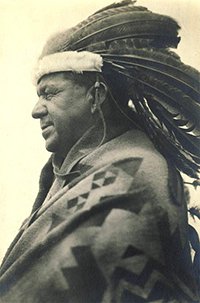
The photo above is of Catawba Indian family members who--an inscription on the back states--were summer residents at a place called "Schoenbrunn State Memorial Park" near New Philadelphia OH. An AZO symbol on the back of the card is dated 1927-40. (Today there is actually a historical site at New Philadelphia called "Schoenbrunn Village.") The mother and children are making clay-pottery--apparently those familiar Rebecca pitchers (see several examples below)--while the father looks on. He's also depicted in the portrait below right wearing what may not be traditional Catawba Indian headgear. Catawbas known to have demonstrated their skills at Schoenbrunn include Emma & Early Brown, Catherine Sanders Canty, and Evelyn Brown George.
 NOTE: All Catawba Indian pottery pieces shown on this page are from the collection of Susan B. Hilton and are on permanent loan to Hilton Pond Center for Piedmont Natural History; we thank her for her willingness to share this historically significant resource and to allow display of pottery images on these pages. Her pottery ranges in age from very recent to a few items that are nearly a century old; many are unsigned, but all are apparently authentic Catawba Indian pieces. NOTE: All Catawba Indian pottery pieces shown on this page are from the collection of Susan B. Hilton and are on permanent loan to Hilton Pond Center for Piedmont Natural History; we thank her for her willingness to share this historically significant resource and to allow display of pottery images on these pages. Her pottery ranges in age from very recent to a few items that are nearly a century old; many are unsigned, but all are apparently authentic Catawba Indian pieces.
Please contact us at FUNDING if you are interested in donating Catawba Indian pottery or providing funds to help expand the Center's collection. Such gifts are tax-deductible at your designated market value of the pot.
All text & photos © Hilton Pond Center; do not use or duplicate in any way
Photo above courtesy Joel Nichols, Winthrop University Archives.)
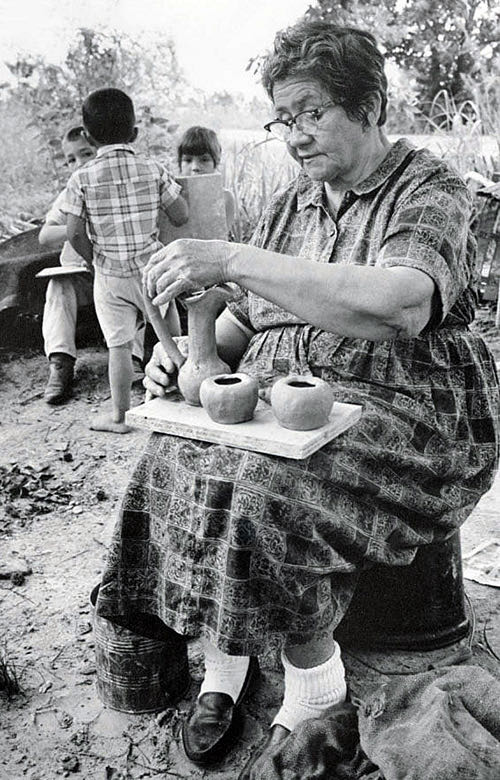
Catawba potter Arzada Sanders (above, 1967),
affixing handle to a Rebecca pitcher.
THE POTTERY
NOTE: The greenish tint on many pieces depicted on these pages is a lighting artifact--the result of taking our photos outdoors under a leafy canopy of green trees. Most Catawba pottery is semi-shiny gray-black, plus other highlight colors that are brought out when the clay is in close contact with embers during the firing process.
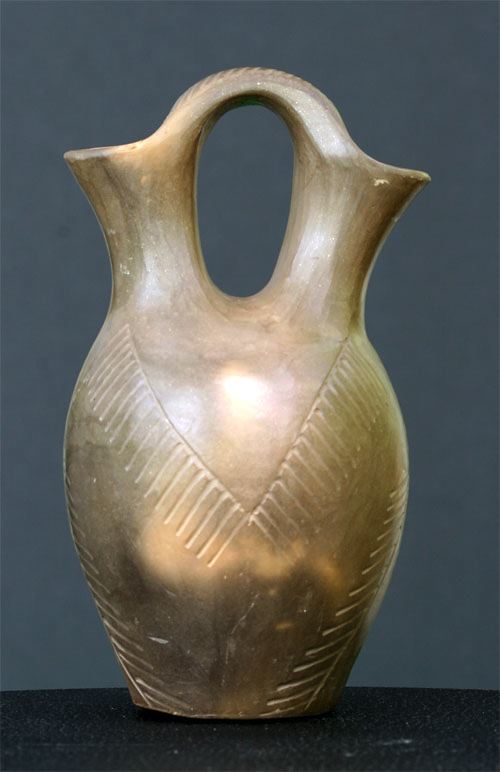
Wedding Vase, Incised, with Short Loop Handle
(6.5" x 3.5"; unsigned & undated)
All text & photos © Hilton Pond Center; do not use or duplicate in any way
One of the most common themes for Catawba pottery was the "Wedding Jug" (see example above). An oral tradition within the tribe is that following the wedding ceremony the bride drinks from one spout of the jug and the groom from the other, after which they throw the pot behind their backs. The number of pieces into which it breaks tells how many children the couple will have.
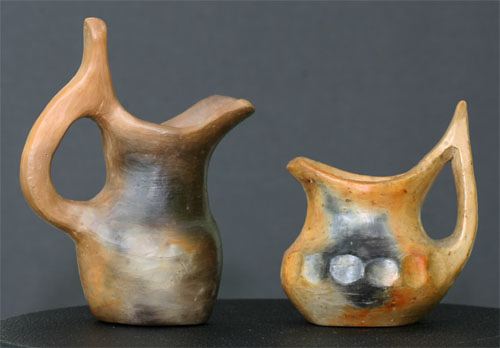
Two Small Rebecca Pitchers
(Left: 6" x 4.75"; pitcher; signed by Florence Wade, 1993)
(Right: 4.5" x 3.75"; pitcher, embossed;
signed "Catawba Indian" & undated)
All text & photos © Hilton Pond Center; do not use or duplicate in any way
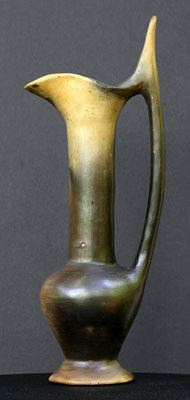
Another theme frequently used by the Catawbas is the "Rebecca Pitcher," the general shape of a "ewer" with a single, tall, looping handle and a single flared spout (see examples above and just below). This form dates back at least 2,000 years in the Middle Eastern tradition and, as such, is one of the older pottery styles still in use worldwide. This form is a favorite of Southern potters; it is believed Catawba Indian artisans adopted it from early settlers. Rebecca Pitchers are quite artistic but not very functional for water-dipping because of the tall handle. (NOTE: The name "Rebecca Pitcher" has been used for at least 200 years and supposedly honors the Old Testament woman described in Genesis as coming to a well with a water jar on her shoulder.)
Please scroll down for photos of other items in the Center's collection. (Check back later as we add descriptions and images for new pieces.)
All text & photos © Hilton Pond Center; do not use or duplicate in any way
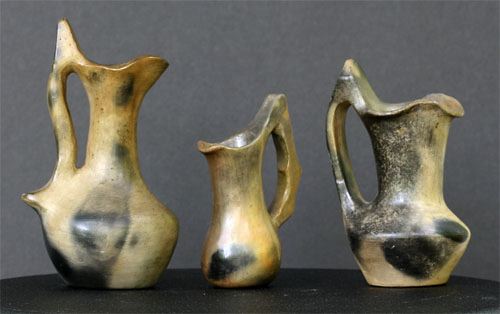
Three Small Rebecca Pitchers
(Left: 5.5" x 3.25"; pitcher; unsigned & undated)
(Center: 4" x 2.5"; pitcher; unsigned & undated)
(Right: 4.75" x 2.75"; pitcher; signed but illegible, undated)
All text & photos © Hilton Pond Center; do not use or duplicate in any way
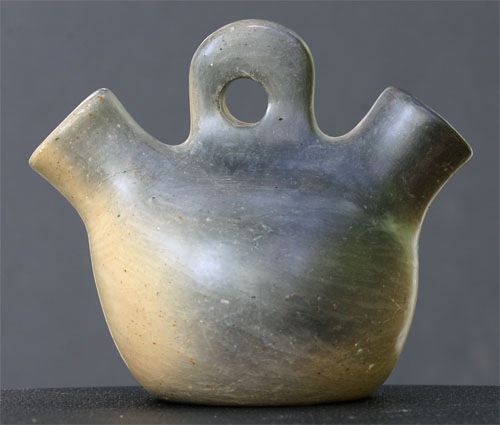
Two-necked Round Wedding Vase with Ring Handle
(5.75" x 5"; signed by Viola Robbins; 1997)
All text & photos © Hilton Pond Center; do not use or duplicate in any way
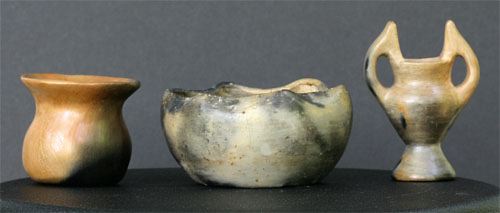
Three Small Pieces
(Left: 2.5" x 2.75"; bowl inscribed with leaves; signed by
Kimberly Ann Page, 1996)
(Center: 2.25" x 4.5"; bowl with scalloped lip; unsigned & undated,
but from the 1950s or earlier)
(Right: 3.75" x 2.75"; symmetrical two-handled vase with unusual
hollow base; signed "Catawba Indian" & undated)
All text & photos © Hilton Pond Center; do not use or duplicate in any way
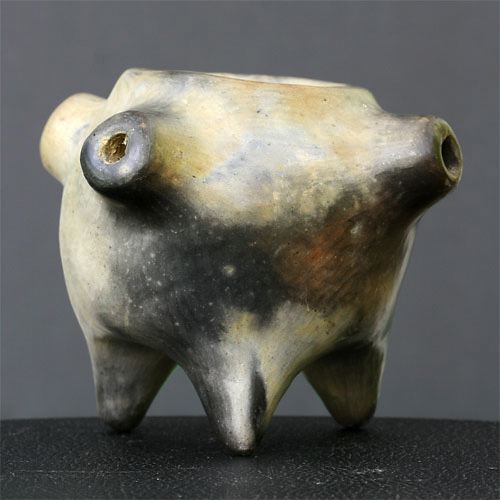
Four-hole Bowl Pipe
(5" x 4"; reeds were placed in each of the four side holes and the smoke mixture was placed in the center of the bowl; unsigned & undated, but from the 1950s or earlier)
All text & photos © Hilton Pond Center; do not use or duplicate in any way
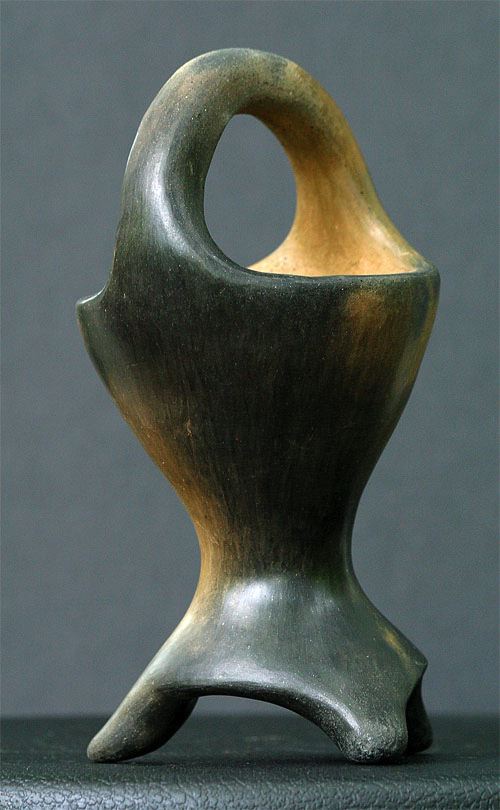
Basket Stand
(6.75" x 3.5"; signed by Catawba potter Reola Harris 1921-1991,
who was twin sister of Viola Robbins and well-known for animal
effigies; Reola began signing pottery in about 1979, so this piece
likely dates to the late 1970s or 1980s)
All text & photos © Hilton Pond Center; do not use or duplicate in any way
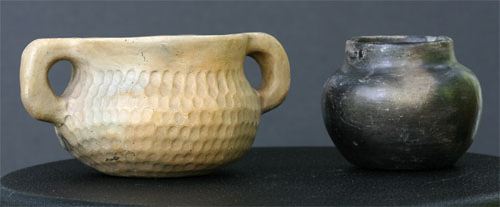
Two Small Bowls
(Left: 6" x 3"; heavily embossed bowl with handles; unsigned & undated)
(Right: 3.5" x 2.75"; unsigned & undated, but a well-worn piece
probably from about 1920)
All text & photos © Hilton Pond Center; do not use or duplicate in any way
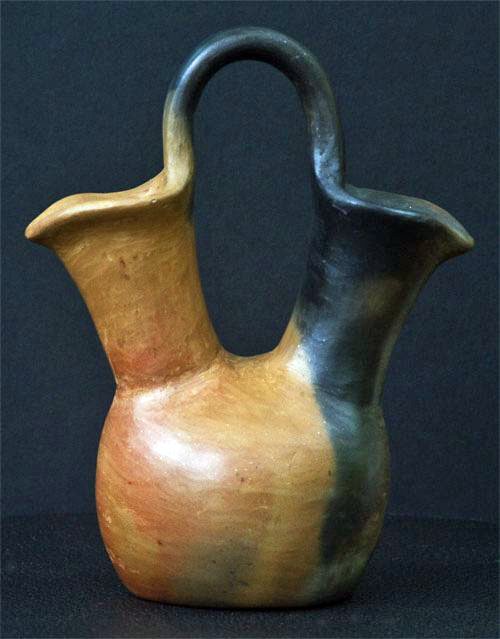
Round Wedding Vase with Loop Handle and Flanged Spouts
(6.5" x 5"; a nice bicolored piece with well-formed flanges signed
by Sara Ayers; 1987)
All text & photos © Hilton Pond Center; do not use or duplicate in any way
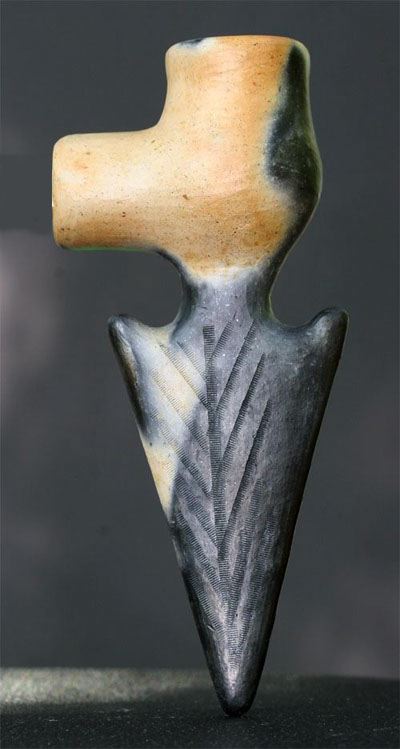
Large Arrowhead Pipe
(5" x 2.5"; signed by Earl Robbins; 1991)
All text & photos © Hilton Pond Center; do not use or duplicate in any way
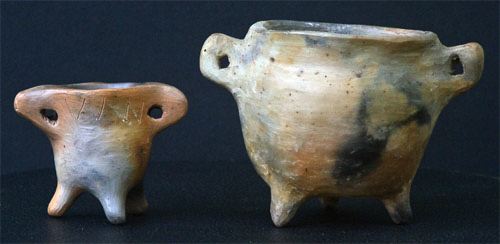
Two Small Three-legged Pots with Handles
(Left: 2.5" x 3"; a rather primitive small pot with rough incising; signed by F.H. Wade, which would be Florence Wade; 1993)
(Right: 3.5" x 5"; another primitive three-legged pot; unsigned & undated)
All text & photos © Hilton Pond Center; do not use or duplicate in any way
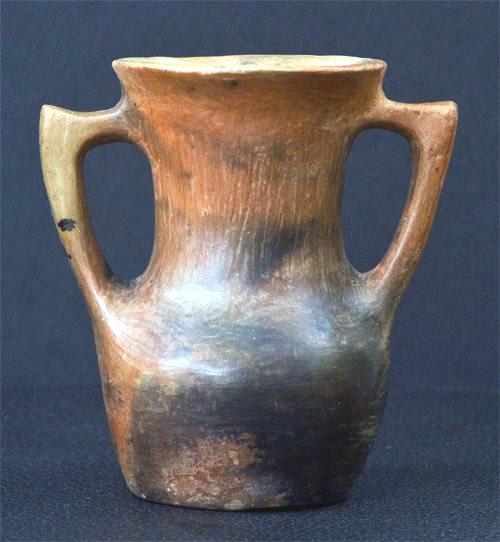
Symmetrical Two-handled Vase
(4" x 3.75"; rare piece made and signed by Foxx Ayers,
AKA Hazel Ayers, husband of Sara Ayers; 1989)
All text & photos © Hilton Pond Center; do not use or duplicate in any way
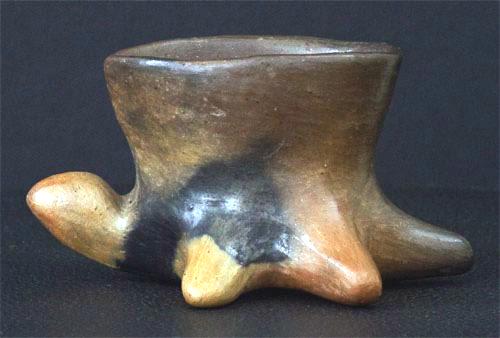
Turtle Effigy Bowl
(2.5" x 4.5"; unusual design of a small bowl formed atop a
turtle effigy; signed by Beulah Harris; 2006)
All text & photos © Hilton Pond Center; do not use or duplicate in any way
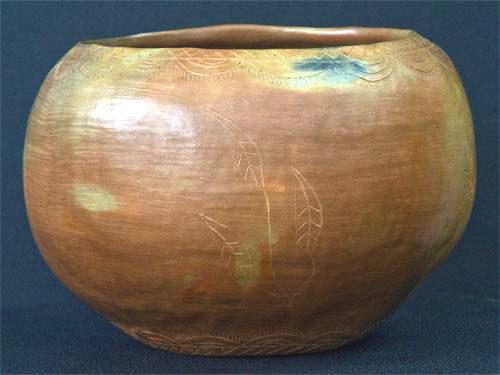
Medium Incised "Apple" Bowl
(5.25" x 7"; acquired through Monty Hawk Branham; medium
hand-formed bowl with rim etchings and very thin walls
characteristic of signed work of Cheryl Harris Sanders; 2000)
All text & photos © Hilton Pond Center; do not use or duplicate in any way
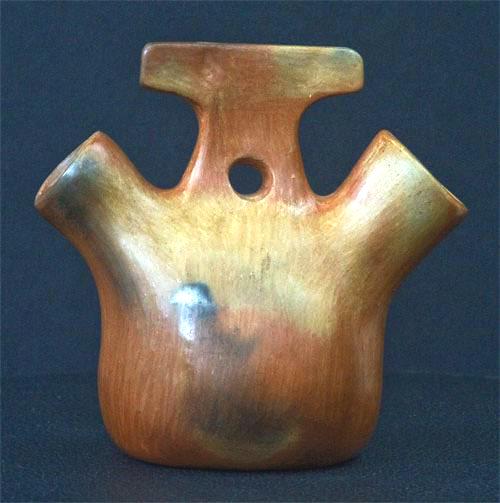
Two-necked Round Wedding Vase with T-Hanger
(5" x 5"; signed by Cora Harris Hedgepath; 2009)
All text & photos © Hilton Pond Center; do not use or duplicate in any way

Small Ash Tray and Wedding Vase
(Left: 1.75" x 3.5"; simple but nicely crafted piece likely made for
roadside trade; unsigned & undated; likely from the 1950s or earlier)
(Right: 3.5" x 3.25"; small wedding vase with loop handle;
unsigned & undated; likely from the 1950s or earlier)
All text & photos © Hilton Pond Center; do not use or duplicate in any way
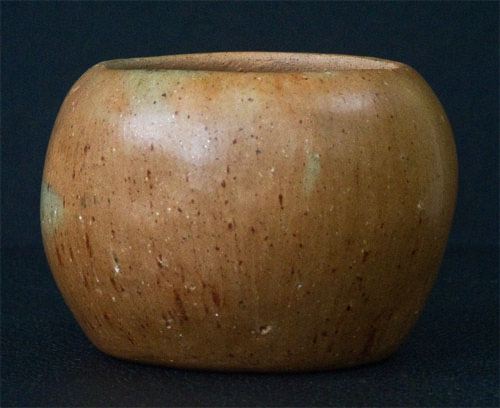
Small "Apple" Bowl
(2.5" x 3.5"; small utilitarian bowl with orange speckles;
signed by Margaret Robbins; 1997)
All text & photos © Hilton Pond Center; do not use or duplicate in any way
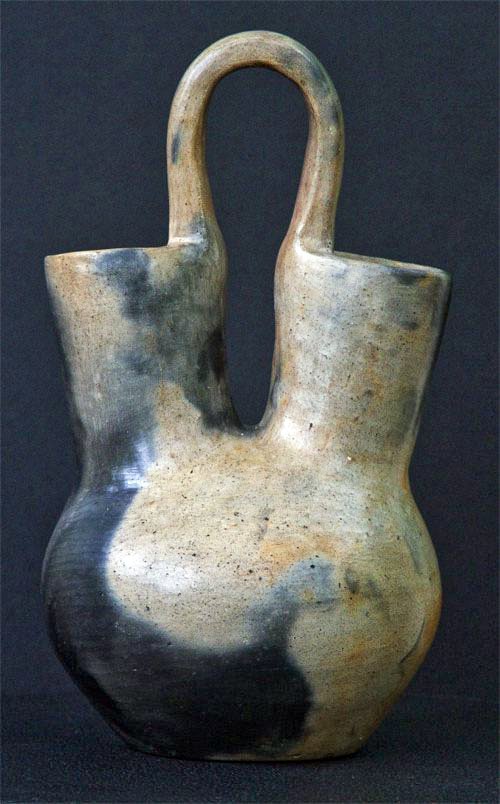
Large Two-necked Round Wedding Vase with Loop Handle
(10.25" x 5.25"; signed by Lillie Bryson, b. 1876-d. 1951;
undated, likely from the 1930s or 1940s)
All text & photos © Hilton Pond Center; do not use or duplicate in any way
Photo Coming
Two-necked Round Wedding Vase with Loop Handle
(4" x 3.5"; signed by Edna Brown, b. 1911-d. 1985; dated 1970.
Edna learned pottery art from her mother Rosie Harris Wheelock,
b. 1880-d. 1935)
All text & photos © Hilton Pond Center; do not use or duplicate in any way
Photos of other pieces will follow; please check back.
OTHER CATAWBA INDIAN INFORMATION
The Blacksnake in Catawba Indian Art and Culture
by Thomas J. Blumer, Ph.D
Blumer, T. J. 1987. Bibliography of the Catawba. Scarecrow Press, Metuchen NJ, 547 pp.
Blumer, T. J. 2003. Catawba Indian Pottery: The Survival of a Folk Tradition. Univ. Alabama Press, 240 pp.
Blumer, T. J. 2004. The Catawba Indian Nation of the Carolinas. Arcadia Publ., South Carolina, 128 pp.
Blumer, T.J. 2007. Catawba Indian Nation: Treasures in History. History Press, 125 pp.
Bradford, W. R. 1946. The Catawba Indians of South Carolina. South Carolina Dept. Educ., Columbia, 31 pp.
Brown, D. S. 1966. The Catawba Indians: People of the River. Univ. South Carolina Press, Columbia, 400 pp.
Hudson, C. M. 1970. The Catawba Nation. Univ. Georgia Monographs #18, Athens, 142 pp.
Merrell, J. H. 1989. The Catawbas. Chelsea House Publishers, Philadelphia, 112 pp.
Merrell, J. H. 1989. The Indians' New World: Catawbas and Their Neighbors from European Contact Through the Era of Removal. Univ. North Carolina Press, Chapel Hill, 400 pp.
Moore, D.G. 2002. Catawba Valley Mississippian: Ceramics, Chronology, and Catawba Indians. Univ. Alabama Press, 352 pp.
Pettus, L. 2005. Leasing Away a Nation: The Legacy of Catawba Indian Land Leases. Palmetto Conservation Foundation, 99 pp.
Scaife, H. L. 1896. History and Condition of the Catawba Indians of South Carolina. Office if Indian Rights Assn., Philadelphia.
Speck, FG. 1969. Catawba Texts. Reprinted by AMS Press, New York, 91 pp.
All text & photos © Hilton Pond Center; do not use or duplicate in any way
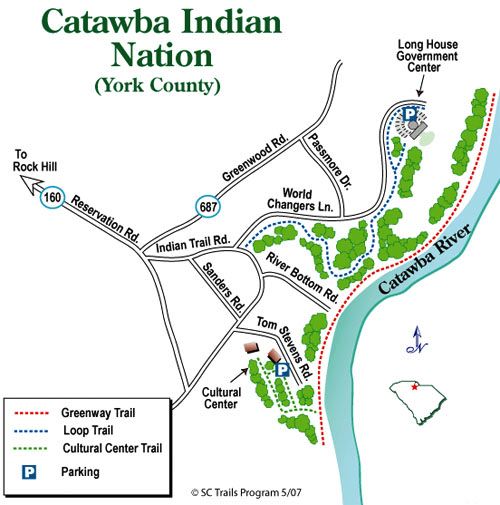
Catawba Indian pottery is sometimes available through the tribe's headquarters east of Rock Hill SC, where there are also exhibits about Catawba history and culture (see map below).
All text & photos © Hilton Pond Center; do not use or duplicate in any way
|





 Hilton Pond Center for Piedmont Natural History is a non-profit research & education organization in York, South Carolina USA; phone (803) 684-5852. Directed by