|
OVERVIEW
Based upon six very successful expeditions in 2004-2008, Hilton Pond Center for Piedmont Natural History--in conjunction with Holbrook Travel--is again offering exciting and educational field trips in January & February 2009 to study Ruby-throated Hummingbirds on their wintering grounds in Costa Rica. Plus, we're adding an extra day to each trip in 2009 so that each is nine days long!
 Ruby-throated Hummingbirds Archilochus colubris--which occur in 38 U.S. states and across southern Canada from April through early October--are the most widely distributed hummingbird species. Nonetheless, they are poorly studied in Mexico and Central America where they spend their non-breeding months. Ruby-throated Hummingbirds Archilochus colubris--which occur in 38 U.S. states and across southern Canada from April through early October--are the most widely distributed hummingbird species. Nonetheless, they are poorly studied in Mexico and Central America where they spend their non-breeding months.  During our nine-day field trips in 2009 to Guanacaste Province in northwestern Costa Rica, Center director Bill Hilton Jr. will show participants how hummingbirds are observed, captured, banded, and released and teach how to implement observational protocols that are part of "Operation RubyThroat: The Hummingbird Project" and The GLOBE Program. Along the way participants will help with many aspects of field work, visit diverse habitats, and learn about fascinating aspects of Costa Rican natural history and culture--from volcanoes to Pacific coastal ecosystems, from coatimundis to tropical butterflies. During our nine-day field trips in 2009 to Guanacaste Province in northwestern Costa Rica, Center director Bill Hilton Jr. will show participants how hummingbirds are observed, captured, banded, and released and teach how to implement observational protocols that are part of "Operation RubyThroat: The Hummingbird Project" and The GLOBE Program. Along the way participants will help with many aspects of field work, visit diverse habitats, and learn about fascinating aspects of Costa Rican natural history and culture--from volcanoes to Pacific coastal ecosystems, from coatimundis to tropical butterflies.
All text & photos © Hilton Pond Center
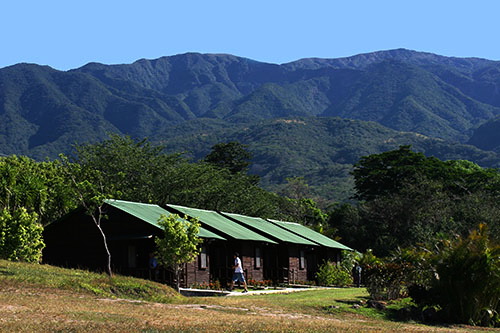
Each nine-day expedition will be based at Buena Vista Lodge & Adventure Center (above), used by many international tour companies because of its accommodations, food, and proximity to outstanding Costa Rican nature locales. The rustic-but-comfortable cabins have hot and cold running water, clean towels daily, private indoor toilets and showers, room fans, and screened windows; the dining room offers fresh fruit, meats, and vegetables at every meal, so you defintely won't be "roughing it."
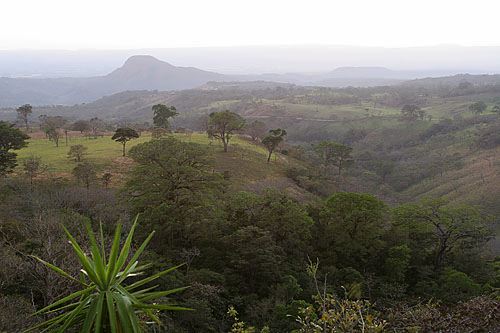
Guanacaste Province, in northwestern Costa Rica (red star on map below), borders Nicaragua. Unlike the Caribbean side of the Costa Rica, the west coast is drier; rather than tropical rain forests, Guanacaste has tropical DRY forests--some of which are evergreen--and there are expanses of grassland that even today are used by cattle and horse ranchers. Some ecologists liken the terrain, climate, and vegetative structure of Guanacaste to that of West Texas in the United States--except there are several active volcanoes overlooking pristine Pacific beaches in Guanacaste!

The trip is open to ANY adult interested in studying and reporting observations of hummingbirds in Costa Rica (and--after the trip--in the the rest of Central America, Mexico, Canada, and/or the U.S.). You do NOT have to be an experienced birder or scientist or have advanced training. We will teach you everything you need to know to participate in the project. Although you will not do the actual banding of hummingbirds, you will be involved in every other way, including handling and releasing hummers and other colorful tropical birds, making valuable field observations, deploying mist nets and traps, collecting and recording data, etc. You will NOT be disapppointed!
Our 2009 expeditions to the wintering grounds of Ruby-throated Hummingbirds are scheduled for 24 January-1 February; 3-11 February; and 13-21 February. We especially encourage participation by K-12 teachers and will be happy to collaborate with them on efforts to find grants to help underwrite trip costs and/or to work with home institutions if they seek graduate credit for the experience. (NOTE: There's also an option for a U.S. or Canadian teacher to travel and participate for FREE by recruiting 14 high school students for a special 7-, 8-, or 9-day trip; student trips can be scheduled anytime November through late February. Please contact us for details.)
Costa Rican K-12 educators sometimes receive full scholarships from Hilton Pond Center and Holbrook Travel to join the adult excursions as active participants. If so, their involvement helps create connections with fellow educators and students from other countries in which Ruby-throated Hummingbirds also occur.
After reading the information below, please contact Debbie Sturdivant at Holbrook Travel (1-866-748-6146) if you have any questions about enrolling and/or to request enrollment forms. Register early to guarantee you can participate!
ITINERARY HIGHLIGHTS
- Observation, trapping/netting, and handling, banding & release of Ruby-throated Hummingbirds in the field
- Up-close in-hand examination of many migrant and resident Neotropical bird species
- Training & certification for GLOBE’s hummingbird observation protocols
- Pacific Coastal Ecosystems field trip to Santa Rosa National Park and to Junquillal Beach, including swimming in the surf
- Half-day visit to city of Liberia to shop, eat & participate in local culture
- Exploration of volcanic hot springs (optional)
- Plenty of opportunities for independent exploration and observation and photography of fascinating tropical plants and animals
All text & photos © Hilton Pond Center
EDUCATIONAL CONNECTIONS
- Hummingbird Observation & Banding
- Neotropical Migrant Bird Behavior
- In-hand Views of Non-migratory Tropical Birds
- Coastal Ecosystems Ecology
- Tropical Dry Forest Ecology (deciduous & evergreen)
- Nocturnal Animal Behavior
- On-site Serpentarium
- Biodiversity
- Volcanology & Landforms
- Conservation
- Nature Photography
- Pedagogical Field Techniques
- Research Field Techniques
- Costa Rican History & Culture
- Full Certification in the Operation RubyThroat/GLOBE Hummingbird Observation Protocols
- Optional graduate credit is available through Weber State University (some trip costs may be deductible as educational expenses and/or be eligible for loans or scholarships from outside sources; teachers should ask principals and district offices if partial funding is available locally)
All text & photos © Hilton Pond Center
HUMMINGBIRD DIVERSITY
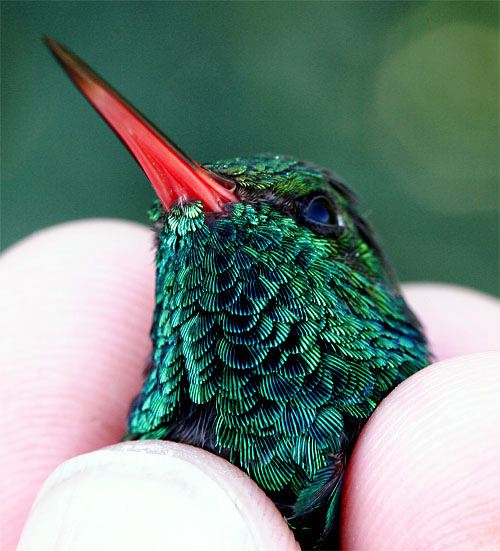
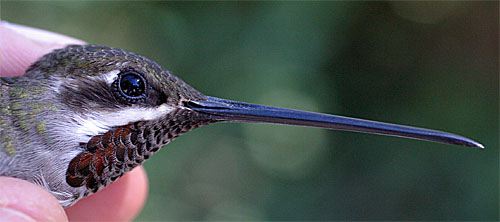
- In additional to banding Ruby-throated Hummingbirds during our previous expeditions to Guanacaste Province, we've also captured the following seven non-migratory hummer species: Canivet's Emerald (formerly Fork-tailed, male above), Cinnamon Hummingbird, Steely-vented Hummingbird, Green-breasted Mango, Rufous-tailed Hummingbird, Blue-throated Goldentail, and the noticeably long-billed Plain-capped Star-throat (below).
All text & photos © Hilton Pond Center
ACTIVE ADVENTURES
(all optional)
- Horseback riding
- Swimming
- Day hiking
- Nature exploring & photography
- Night hikes
- Zip line through the canopy
- Unique tropical forest water slide
WEEK ONE DETAILED ITINERARY
(24 Jan-1 Feb 2009, Saturday through following Sunday)
Weeks Two (3-11 February) and Three (13-21 February) follow the same itinerary but on different weekdays; "weeks" are actually nine days long, including a travel day on either end.
DAY 1: January 24 (Saturday)--Arrival & Buena Vista Lodge & Adventure Center
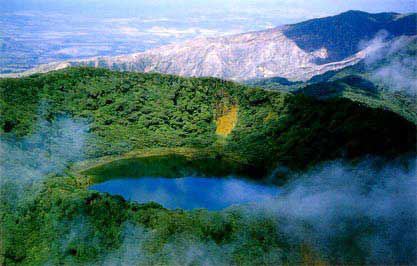
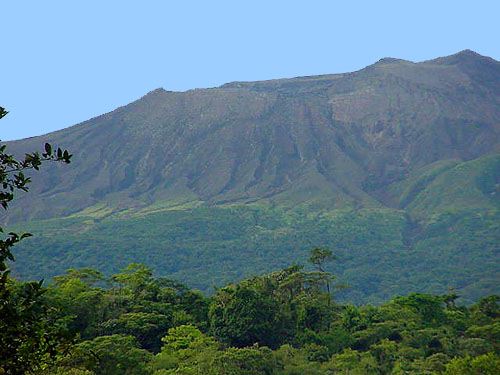
- Early Afternoon: Arrive Liberia International Airport, greeted by local personnel; lunch on your own at airport. Transported by air-conditioned tour bus to Buena Vista Lodge near Rincon de la Vieja National Park (above), home base for the week. Formerly a cattle ranch, the Lodge now focuses on ecotourism. Keeping its rustic style, the property sits on a volcanic slope (altitude 2,450') with the Pacific Ocean visible in the distance. The peak of the volcano is shrouded in clouds and is seldom visible, but in the mist frequent rainbows--and occasional moonbows!--make up for it. Of the Lodge's 2,000 acres of private reserve, approximately half are primary (virgin) and secondary forest with the rest dedicated to livestock and equestrian activities--a big part of the Guanacaste lifestyle. The Lodge's finca (working farm) also produces organic foods, including fruits, vegetables, milk & cheese.
- Evening: Introductions & Overview of Operation RubyThroat/GLOBE protocols and other methodologies to be used while monitoring, capturing & banding Ruby-throated Hummingbirds (Archilochus colubris).
DAY 2: January 25 (Sunday)--Buena Vista & Canas Dulces
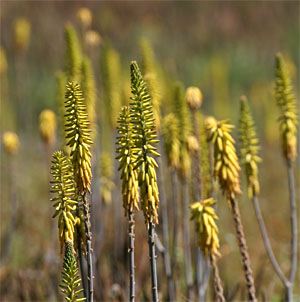
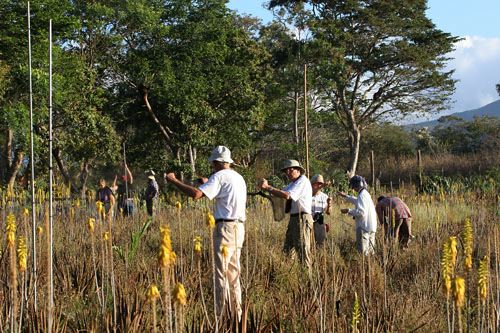
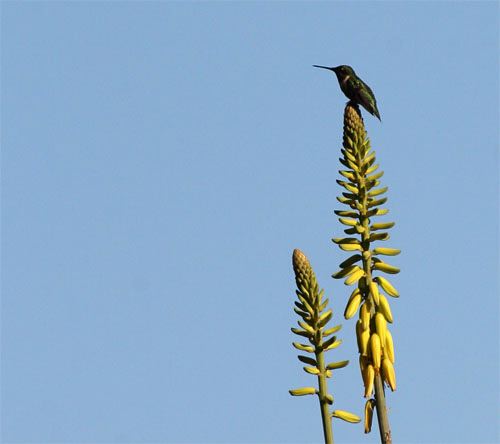
- Morning: Breakfast at the Lodge (occurs daily, unless otherwise noted). Bus to Canas Dulces for Day One of field work; make observations; scout for concentrations of hummingbirds; set traps and/or nets at various sites, including Aloe Vera plantations (photo, below right) that may be one of the most important local habitats for wintering Ruby-throated Hummingbirds; record data; band and release hummingbirds as captured.
- Lunch: Back at the Lodge (occurs daily, unless otherwise noted).
- Afternoon: Explore Buena Vista grounds on your own; great chances for observations and photos of local flora and fauna.
- Late Afternoon: Gather at El Mirador to watch sunset over Pacific Ocean.
- Supper: At the Lodge (occurs daily, unless otherwise noted).
- Evening: Continuation of Operation RubyThroat/GLOBE protocol instruction. Informal presentations by trip participants. (On at least one evening we will have opportunity for an optional night hike to observe nocturnal inhabitants of the Buena Vista reserve.)
DAY 3: January 26 (Monday)--Buena Vista & Canas Dulces
- Morning: Day Two of hummingbird observations and banding at study site(s).
- Afternoon: Explore Buena Vista grounds on your own.
- Late Afternoon: Gather at El Mirador.
- Evening: Continuation of Operation RubyThroat/GLOBE protocol instruction. Informal presentations and introduction to Costa Rican culture.
DAY 4: January 27 (Tuesday)--Buena Vista, Canas Dulces, Santa Rosa National Park & Junquillal Beach
- Morning: Day Three of hummingbird observations and banding at study site(s).
- Late Morning/Afternoon: Field trip to and box lunch at Santa Rosa National Park. Created to preserve the field where a decisive battle was fought, Santa Rosa is a naturalist's wonder.
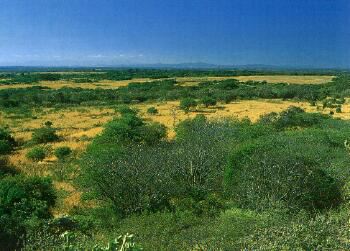 The park, covered with trails, encompasses almost all habitats of the region, from deciduous tropical hardwood forests to dry mountain regions (with cactus and thorny shrubs) to mangrove swamp estuaries near the beach. Excellent opportunities for wildlife observation and photography exist during the dry season, due to concentrations of animals at water holes. Within park boundaries are the beaches of Nancite and Naranjo, both among the most pristine in Costa Rica and known for mass nestings of sea turtles. Visit Junquillal Beach for an introduction to tropical coastal ecosystems. Swim in Pacific Ocean (optional). The park, covered with trails, encompasses almost all habitats of the region, from deciduous tropical hardwood forests to dry mountain regions (with cactus and thorny shrubs) to mangrove swamp estuaries near the beach. Excellent opportunities for wildlife observation and photography exist during the dry season, due to concentrations of animals at water holes. Within park boundaries are the beaches of Nancite and Naranjo, both among the most pristine in Costa Rica and known for mass nestings of sea turtles. Visit Junquillal Beach for an introduction to tropical coastal ecosystems. Swim in Pacific Ocean (optional).
- Evening: Continuation of Operation RubyThroat/GLOBE protocol instruction. Informal presentations and optional night hike.
DAY 5: January 28 (Wednesday)--"Hump Day" at Buena Vista
- Morning & Afternoon: Explore Buena Vista grounds on your own. Stalk wildlife for unforgettable photos. Optional activities such as horseback ride to the volcanic spa; also, water slide, zip line, canopy tour, Serpentarium, etc.
- Late Afternoon: Gather at El Mirador.
- Evening: Informal presentations and introduction to Costa Rican culture.
All text & photos © Hilton Pond Center
DAY 6: January 29 (Thursday)--Buena Vista & Canas Dulces
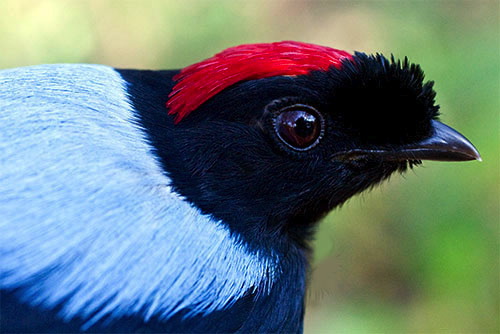
- Morning: Day Four of hummingbird observations and banding at study site(s). (Often we catch and release other tropical bird species, such as the male Long-tailed Manakin above.)
- Afternoon: Explore Buena Vista grounds on your own.
- Late Afternoon: Gather at El Mirador.
- Evening: Informal presentations and introduction to Costa Rican culture.
DAY 7: January 30 (Friday)--Buena Vista, Canas Dulces & Liberia
- Morning: Day Five of hummingbird observations and banding at study site(s).
- Afternoon: Trip to Liberia for family-style lunch at ethnic restaurant on the town plaza; time to shop, sightsee, and catch local flavor.
- Late Afternoon: Gather at El Mirador.
- Evening: Informal presentations and introduction to Costa Rican culture.
DAY 8: January 31 (Saturday)--Buena Vista & Canas Dulces
- Morning: Day 6 of hummingbird observations and banding at study site(s).
- Afternoon: Explore Buena Vista grounds on your own. Begin packing for next day's departure.
- Late Afternoon: Gather at El Mirador.
- Evening: Final analysis of hummingbird data & "Farewell Fiesta."
DAY 9: February 1 (Sunday)--Buena Vista & Departure
- Morning: Depart for Liberia airport for flight home (hugs optional but likely among new friends).
- Evening: Dream in your own hometown bed about hummingbirds and warm, sunny Costa Rica!
VERY IMPORTANT NOTE: The main purpose of any Operation RubyThroat expedition is to learn about Ruby-throated Hummingbird "winter" behavior; thus, your active participation in making daily observations and collecting data is critical to the trip's success. We expect you to take initiative, carry your share of the load, and listen to and follow instructions carefully for the sake of the welfare of other participants and the hummingbirds we work with. We will have many wonderful and enjoyable experiences together, but this is NOT a pleasure trip--even though you'll have plenty of free time and are certain to have fun. If you are not willing to work hard all week and follow the expedition's research and education goals, please do not sign up for the trip; we NEED your help in the field, and our success will depend on you. Most days involve early through late morning field work under warm to hot conditions and after-supper meetings, with afternoons open for you to do as you wish. Scheduled activities are subject to change due to weather or to take advantage of unexpected learning and research opportunities, but we'll do everything we can to make sure we offer all non-research activities described above.
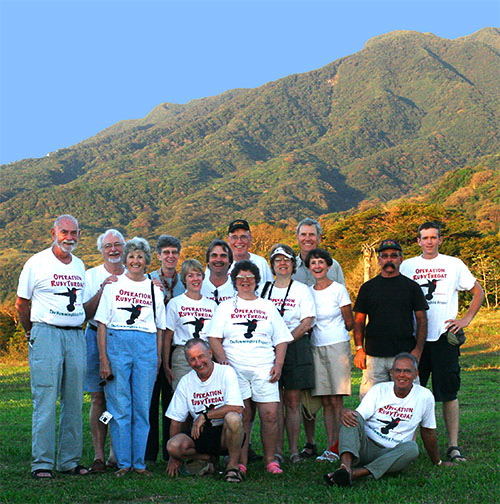
BILL HILTON JR. (below left), internationally known educator-naturalist, was twice named South Carolina Science Teacher of the Year and was honored as the state's Outstanding Biology Teacher. In 1998, The Charlotte Observer named him a Carolinas "Guardian of the Environment" for a lifetime of trend-setting work in conservation and environmental education. He has led nine highly successful hummingbird expeditions to Costa Rica. 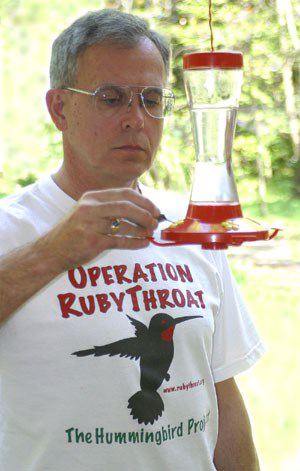 The December 2008 issue of Discover magazine cited Hilton as one of the top ten amateur scientists in America and one of the nation's "50 Best Brains in Science." The December 2008 issue of Discover magazine cited Hilton as one of the top ten amateur scientists in America and one of the nation's "50 Best Brains in Science."
Hilton is executive director of Hilton Pond Center for Piedmont Natural History. As principal investigator for "Operation RubyThroat: The Hummingbird Project," he received a 42-month grant from the National Science Foundation to integrate Operation RubyThroat with The GLOBE Program. Since 1982, Hilton has banded more than 52,000 birds at Hilton Pond, including nearly 4,000 Ruby-throated Hummingbirds.
Hilton taught in Rock Hill and Fort Mill SC schools, and at the University of Minnesota, St. Olaf College, and Winthrop University. He helped start the residential South Carolina Governor’s School for Science and Mathematics in Hartsville, which he served as biology instructor and director of student research.
Hilton is a nationally sought-after speaker on diverse natural history topics. He has a Bachelor of Arts in Philosophy from Newberry College, which he served as president of the Alumni Association. In this role, he organized a major international symposium on John Bachman, founder of Newberry College and a contemporary of John James Audubon. Hilton earned a Master of Arts in Biology Teaching from Winthrop University, and a Master of Science in Ecology & Behavioral Biology from the University of Minnesota, where he conducted a four-year field study of the behavioral ecology of Blue Jays, Cyanocitta cristata. For a complete resume, see his Biographical Sketch.
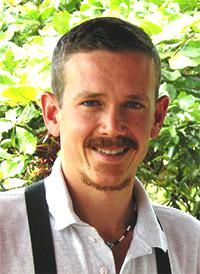 Hilton and the group will be assisted by ERNESTO M. CARMAN JR. of Talamanca Hawkwatch and Programa Conservacion de Aves. Ernesto (at right), a native-born Costa Rican (tico), speaks fluent English and Spanish, and is one of only a few naturalists with extensive experience observing Ruby-throated Hummingbirds within Costa Rica. Ernesto's sharp eyes and ears, comprehensive knowledge, and terrific personality greatly enrich our time in the field. After five years of involvement with the project he is a true collaborator and not just an in-country guide. Ernesto's family runs Finca Cristina, an environmentally friendly coffee farm that uses shade-grown organic techniques and recycles processing materials. Hilton and the group will be assisted by ERNESTO M. CARMAN JR. of Talamanca Hawkwatch and Programa Conservacion de Aves. Ernesto (at right), a native-born Costa Rican (tico), speaks fluent English and Spanish, and is one of only a few naturalists with extensive experience observing Ruby-throated Hummingbirds within Costa Rica. Ernesto's sharp eyes and ears, comprehensive knowledge, and terrific personality greatly enrich our time in the field. After five years of involvement with the project he is a true collaborator and not just an in-country guide. Ernesto's family runs Finca Cristina, an environmentally friendly coffee farm that uses shade-grown organic techniques and recycles processing materials.

2009 LAND PROGRAM COST: $1,595
(Please e-mail Wendy Frazier, Holbrook Travel's air specialist, for international airfare rates from your city. Holbrook often has access to "add-on" airfare at rates cheaper than those available to the general public.)
--Rates are based on: Double occupancy with a full roster of 12 participants and subject to increase with fewer participants. (Any participant may select a single room for an additional $335 but we recommend doubling as part of the community experience.)
--Participants must be: At least 21 years of age by the time the trip begins, and willing and able to participate in field work and all education and research activities. (Special consideration may be given on a case-by-case basis for college students and for advanced, mature high school students accompanied by a parent. We also can offer a full week for a class of 12-14 responsible high school students between November and late February; the sponsoring teacher earns a FREE trip. Please contact us for details.)
--Each participant must: Have and know how to use a decent pair of binoculars with which to make field observations.
--Participants must be: In good physical & mental health and able to walk at slow to moderate pace for short distances (usually less than a half mile) over mostly level terrain at the study site, and be able to carry light objects (mist net poles, banding tools, day pack, etc.) in the field. Participants will need to traverse somewhat steeper terrain and/or steps along paved walkways at Buena Vista Lodge in order to access lodging, dining halls, and other facilities. On past expeditions, participants as old as 80+ have had no problems with the minimal physical demands of the project.
--Program cost includes: All in-country transportation, accommodations, meals, expert local guide (bilingual), learning activities and field trips, and Operation RubyThroat/GLOBE instructional materials, as stated above.
--Program cost does not include: International airfare (about $500-$750, depending on departure point); a family-style lunch in Liberia and a meal at airport on departure day; any additional optional activities not described above (e.g. horseback ride, water slide, canopy walk, zip line, etc.); non-mealtime beverages or snacks; gratuities for guide, drivre, and local personnel; $26 departure tax; or graduate credit costs. (Please note that because of difficulty with international connections and depending on your point of origin, it may be necessary for you to spend an extra night traveling to and/or from Costa Rica.)
--Payment policy: To confirm your space, send $200 deposit per person to Holbrook Travel along with your enrollment form(s); deposit for all trips is due on or before 25 September 2008. We suggest early deposit to guarantee your space. Each deposit is refundable minus a $100 processing fee if cancellation is received by 21 October 2008; there will be no refunds for cancellations after that date. Final payment of $1,395 is due on 21 October 2009. (We advise inexpensive third-party trip insurance to cover unexpected circumstances that could cause you to cancel after your final payment is made; such insurance also covers flight delays, in-country medical care, etc.)
--Pre-trip activities: We will communicate with you frequently via e-mail in the weeks leading up to your trip. You'll also receive suggested readings and resources that will enhance your trip experience. We anticipate you will study and learn all important information related to the trip's research goals.
--Optional graduate credit: Contact Holbrook Travel's Debbie Sturdivant for infomation about how to apply and pay for graduate credit through Weber State University. You may also elect to work with your local college to earn credit there. K-12 educators may file for continuing education credits.
--Tax deductions: Because Operation RubyThroat expeditions to Costa Rica are service projects in support of a non-profit, an estimated $400 of your fees should be tax-deductible. If you are participating as part of a college degree program or are a classroom teacher, additional tax deductions may be taken--tin fact, the FULL COST of the trip may be deductible. (In some cases, this means after taxes the trip actually will end up costing you nothing!)
Hilton Pond Center for Piedmont Natural History and Operation RubyThroat: The Hummingbird Project expeditions are non-profit trips offered as outreach activities through which we learn more about winter behavior of Ruby-throated Hummingbirds. If you're interested in making a separate contribution to the Center and/or Operation RubyThroat, please see Supporting the Work of Hilton Pond Center.
After reading the information above, contact Debbie Sturdivant at Holbrook Travel by E-mail or phone (1-866-748-6146) if you have any questions about enrolling and/or to request enrollment forms. You can also ENROLL ON-LINE. See you in Costa Rica!
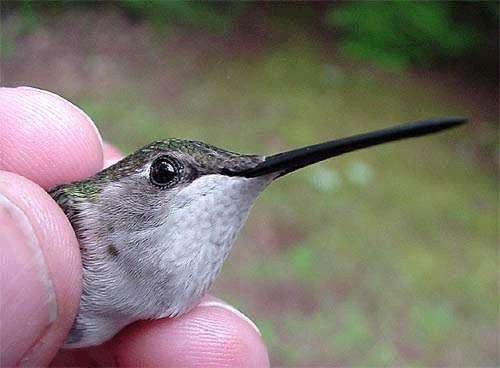
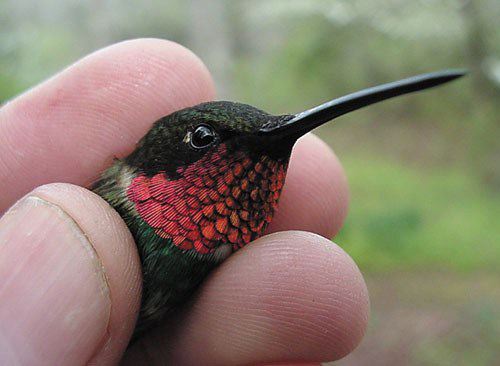
Adult female Ruby-throated Hummingbird (above),
captured for banding
All text & photos © Hilton Pond Center
Other copyrights as indicated
 DATES FOR 2009 ARE DATES FOR 2009 ARE
WEEK ONE: 24 January - 1 February
WEEK TWO: 3-11 February
WEEK THREE: 13-21 February
"Weeks" are actually nine days long, including a travel day on either end.
IMPORTANT NOTE:
Week One is now full; Week Two has five spaces left;
Week Three has one.
You may wait-list for any week in case of cancellations.
For complete reports on our previous successful excursions,
please visit "This Week at Hilton Pond" for
PLUS
See a write-up about the 2006 trip in the
May/June 2006 Costa Rica Outdoors magazine
AND . . .
A first for hummingbird banders! One of our ruby-throats captured in January 2008 in Costa Rica was encountered five months later in Baxley, Georgia USA!
|


 You can also
 Hilton Pond Center for Piedmont Natural History is a non-profit research & education organization in York, South Carolina USA; phone (803) 684-5852. Directed by