HOME: www.hiltonpond.org |
|||

ORIGINS OF
HILTON POND CENTER
(Page updated 08/24/23)
HOME: www.hiltonpond.org |
|||
ORIGINS OF
HILTON POND CENTER
(Page updated 08/24/23)
|
In late 1981, Bill Hilton Jr. was about to finish up an extended study of behavioral ecology of Blue Jays, Cyanocitta cristata (below left), as part of his graduate work at the University of Minnesota. The Hiltons met a Twin Cities realtor who in turn contacted a colleague in York County SC, where the Hilton family had lived and worked prior to moving to Minnesota. The Hiltons challenged the Carolina real estate agent with an interesting set of requirements for their prospective new home:
To make a long story short, the realtor did what Hilton called a "miraculous job" in narrowing down property listings in York County and suggested the family look at a few homes that might meet their demands. In December 1981, the agent took the Hiltons to view several unsatisfactory listings before mentioning a place in York SC: A circa-1918 farm house (above) in excellent shape on two hectares with a few old oaks, pines, Earnest money was put down and the deal was closed in mid-March 1982 with former owner Bobby Bolin (a Hickory Grove SC native and once a pitcher for the San Francisco Giants; 1969 baseball card above right). Hilton and son Billy immediately planted some border plants and put up a few bird feeders and that summer the family moved to the new homestead--which they appropriately named "Hilton Pond." The Hiltons were able to purchase adjoining lots shortly thereafter, so today--more than 33 years later--the property has expanded to about five hectares (11 acres).
The farmhouse the Hiltons purchased was just that--the residence of farming families that had grazed cattle or planted rows crops such as corn, cotton, and soybeans for perhaps a century or more. As a result the land wasn’t very diverse and the land was depleted--"farmed out" with lots of red clay; those decades of plowing had eliminated seeds and roots of most native plants. Hilton vowed early on there was no way he was cutting five hectares (11 acres) of grass to keep the property open so he laid out nearly 4 km (2.5 miles) of walking trails that meandered around the property from one blackberry patch to another, bypassing tiny tree seedlings in the hope they would grow much larger. And grow they did, so much so that more than three decades years later the land is essentially covered by a mixed forest of hardwoods and pine--nearly all of which seeded in naturally thanks to blowing winds and a variety of birds and small mammals. Instead of trails that once snaked through sun-baked Broomsedge, Hilton’s paths now provide shady access to all parts of the property and allow him to intensively observe and investigate changes that occur year-round among diverse flora and fauna of the Carolina Piedmont. There haven't been enough Blue Jays to continue a study similar to what he conducted in Minnesota, but by using mist nets and various kinds of traps, Hilton has captured and banded more than 78,600 birds of 128 species in 41 years! In all, Hilton Pond's local checklists include 173 bird species (27 of which are known to have nested on the property), 31 mammals, 23 reptiles, 12 amphibians, four fish, 34 butterflies, dozens of other insects and invertebrates, 51 trees, 27 shrubs, 20 vines, more than 60 herbs and forbs (including native "wildflowers" and exotics), six aquatics, five ferns, one clubmoss, and many identified (or unidentified) fungi, lichens, mosses, and grasses--plus uncounted aquatic organisms that inhabit the pond. Because of his long-term site-based banding work in the under-studied South Carolina Piedmont, Hilton’s property was named an Important Bird Area by National Audubon and BirdLife International. For several years Hilton’s bird banding and plant and animal inventory work involved his advanced high school science students--he was named South Carolina Science Teacher of the Year on three occasions--but he eventually took leave of the classroom and formally established in 1999 what he now calls Hilton Pond Center for Piedmont Natural History, a nonprofit 501(c)(3) organization dedicated to education, research, and conservation. For the past 20 years the Center has been underwritten in part by the Hilton family and has thrived on private donations, corporate contributions, and a series of small grants--plus a prestigious 42-month award from the National Science Foundation in support Operation RubyThroat: The Hummingbird Project. This cross-disciplinary international initiative uses the Ruby-throated Hummingbird, Archilochus colubris, as a hook to excite students of all ages about science learning. Our NSF grant--unusual for a small non-profit--was provided to allow Hilton to incorporate Operation RubyThroat as an observational protocol within The GLOBE Program, through which students and citizen scientists around the world collects data about atmosphere, climate, soils, hydrology, land cover, and phenology. While Hilton captures Ruby-throated Hummingbirds at Hilton Pond Center (with 7,404 banded locally since July 1984), students and adults in ten countries from Canada to Panama also collect data about when hummingbirds arrive and depart in spring and fall migration, how dense hummingbird populations are in various parts of their nesting and wintering ranges, whether the birds prefer to feed at feeders or on various flower species, and how successful hummingbirds are at breeding from year to year. As part of his work with Operation RubyThroat, during most winters Hilton leads groups of citizen scientists on expeditions to Central America, where he is the only researcher studying Ruby-throated Hummingbirds on their wintering grounds in the Neotropics. Since 2004, he has incorporated adults and college students in his efforts to observe, capture, band, and release 1,540 ruby-throats at study sites in Belize, Costa Rica, El Salvador, Guatemala, and Nicaragua. To date, there have been more than 30 expeditions involving more than 260 participants that help underwrite the research. Hilton chronicles the ongoing activities of his Center on its Web site, particularly through “This Week at Hilton Pond,” an original series of photo essays about everything from birds and bees to flowers and trees and natural phenomena he observes in the Carolina Piedmont and beyond. While “teaching folks about everyday occurrences at the Center,” Hilton said he hopes his work “will stimulate students 'K thru gray' to go out and look for similar organisms and occurrences in their own backyards.” Nearly than 725 "This Week" installments begun in February 2000 are permanently archived and indexed on-line as a rich source of authoritative nature information--some of which is based upon Hilton's original research at the Center. If you’re interested in supporting the multi-faceted work of Hilton Pond Center for Piedmont Natural History, you can make a tax-deductible contribution through PayPal, by credit card via Network for Good, or by shopping on-line at stores that give a small percentage of every sale to the Center. Details are below or at FUNDING. Back to General Info Main Page |
|
Make direct donations on-line via
Network for Good: |
 |
|
Use your PayPal account
to make direct donations: |
|
|
If you like shopping on-line please become a member of iGive, through which 800+ on-line stores from Amazon to Lands' End and even iTunes donate a percentage of your purchase price to support Hilton Pond Center .
 Every new member who registers with iGive and makes a purchase earns an ADDITIONAL $5 for the Center. You can even do Web searches through iGive and earn a penny per search--sometimes TWO--for the cause! Please enroll by going to the iGive Web site. It's a painless, important way for YOU to support our on-going work in conservation, education, and research. Add the iGive Toolbar to your browser and register Operation RubyThroat as your preferred charity to make it even easier to help Hilton Pond Center when you shop. Every new member who registers with iGive and makes a purchase earns an ADDITIONAL $5 for the Center. You can even do Web searches through iGive and earn a penny per search--sometimes TWO--for the cause! Please enroll by going to the iGive Web site. It's a painless, important way for YOU to support our on-going work in conservation, education, and research. Add the iGive Toolbar to your browser and register Operation RubyThroat as your preferred charity to make it even easier to help Hilton Pond Center when you shop. |
|

 post questions for The Piedmont Naturalist |
Join the |
Search Engine for |
|
|
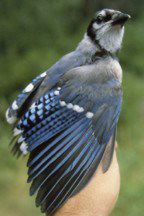 On his primary study site at the University’s Cedar Creek Natural History Area, Hilton banded and color-marked more than 1,500 Blue Jays and found that species’ densest known nesting concentration--an annual average of more than 100 nests in a 60-hectare area. Despite this phenomenal success, after what he calls “four very long, very dark, very cold winters studying Blue Jays in the wilds of Minnesota,” Hilton, his wife Susan, and five-year-old son Billy III were looking forward to returning home to significantly balmier South Carolina, where Hilton planned once again to teach high school biology.
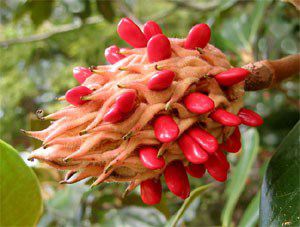 Several hectares of land where Hilton could continue his field ornithology work; some sort of water feature (live stream or pond); a variety of vegetation, including a few mature trees; a livable house in good condition; and, of course, everything had to be at a price affordable to a family that had been living on a tight graduate student budget for four years. The Carolina realtor said she was up for the challenge and was undaunted to learn the Hiltons also wanted the property to have a Southern Magnolia tree, Magnolia grandiflora (fruit, above right)--a symbol they had left the frigid northland behind and moved to a more hospitable climate.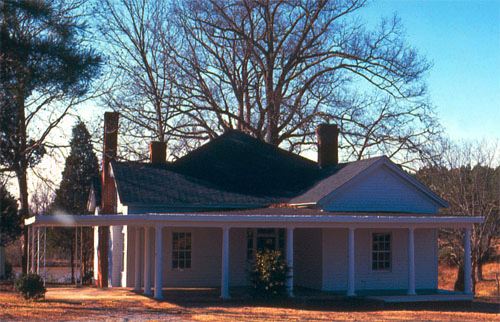
 hickories (photo below), all growing around a 1-hectare pond at an unbelievably low asking price of $47,000. The description seemed too good to be true, but when the Hiltons took their initial tour they knew it was the perfect place--especially since a magnificent magnolia tree stood tall in the front yard!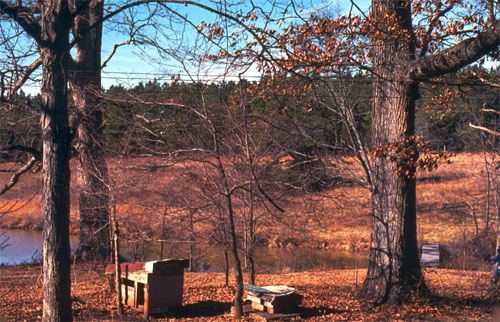
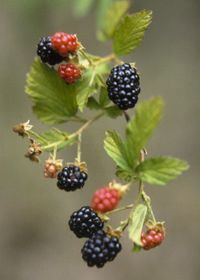 In fact, except for a few big trees around the farmhouse (above), the property was almost completely open and about a year or two into vegetational succession. There was plenty of knee-high Broomsedge (Andropogon virginicus), with a few Blackberry thickets (Rubus spp., fruit at left), expanses of invasive Japanese Honeysuckle (Lonicera japonica), and a scattering of tiny, six-inch-high seedlings of Winged Elm (Ulmus alata), Sweetgum (Liquidambar styraciflua), and Eastern Red Cedar (Juniperus virginiana)--a triumvirate of early successional tree species that does especially well in the iron-rich soil of western York County SC.
 Hilton Pond Center for Piedmont Natural History is a non-profit research & education organization in York, South Carolina USA; phone (803) 684-5852. Directed by