 HOME: www.hiltonpond.org |
|||
PROTOCOL:
HUMANE TREATMENT OF BIRDS
USED IN EDUCATIONAL
BIRD BANDING PROJECTS
AT HILTON POND CENTER
(and at off-grounds sites)
(Adopted January 2000; reviewed & updated October 2012)
|
HOME: www.hiltonpond.org |
|||
PROTOCOL:
HUMANE TREATMENT OF BIRDS
USED IN EDUCATIONAL
BIRD BANDING PROJECTS
AT HILTON POND CENTER
(and at off-grounds sites)
(Adopted January 2000; reviewed & updated October 2012)
|
We conclude that banding can be an important way to educate the public about scientific research, about the miraculous lives of birds, and about birds' vital role in the environment of which we are all a part. It can also serve to encourage the lay public to be better observers. Scholarly research and scientific findings may be of little use if the public is not informed or if they simply don't care. Educational banders can bridge the gap between scientific research and public awareness. from Anderson & Spreyer (1982)
INTRODUCTION Study skins and free-flying wild birds in fields and woodlands are used frequently in resaerch and teaching/learning programs at Hilton Pond Center for Piedmont Natural History near York, South Carolina USA (www.hiltonpond.org). To further educate the public about ornithology and Piedmont ecology, the Center also offers on-site (and off-grounds) public programs that use bird banding to bring birds closer to members and the general public. Although bird banding is employed as an important research tool by the Center and visiting scientists, most of these activities are conducted out of public view. In "educational bird banding," activities are conducted in-view for: School groups (pre-elementary through college), small workshops for members and visitors that require advanced registration, special programs for the general public, and teacher in-service and pre-service sessions. Banding is also used to train the Center's Education Interns in proper techniques for handling and measuring wild birds and for using bird banding as a teaching and research tool. During selected education programs and field trips at the Center, free-flying wild birds are mist-netted or live-trapped; identified, measured, In educational banding programs, each "bird-in-the-hand" may be used as a teaching tool to explain a variety of avian topics including: Evolution, adaptation, morphology, taxonomy, identification, migration, and behavior. Captured birds also help Center educators teach the public about bird research techniques, about what to do with a banded bird if found, about various topics in plant and animal ecology and conservation, and about the importance of supporting work of the Bird Banding Laboratory. To assure that educational banding activities are conducted effectively, humanely, and legally, the Center has established a protocol for all banding conducted in public view. The Center's educational banding protocol is derived, in part, from: Guidelines for the Use of Wild Birds in Research (The Ornithological Council, 1996ff); the federal Bird Banding Manual (1991ff) of the Canadian Wildlife Service and U.S. Fish & Wildlife Service; documents from various committees of the NABC (whose members represent U.S. and Canadian organizations and agencies that use banding for education and/or research); visits to other sites where banding is used in public venues (including Braddock Bay Raptor Research NY, Cape May Bird Observatory NJ, Hawk Mountain Sanctuary PA, and Hawk Ridge MN); interviews with banders involved in educational banding; participation in meetings with representatives of U.S. and Canadian governmental bird banding agencies; and other ornithological and science education literature.
All text & photos © Hilton Pond Center BENEFITS OF EDUCATIONAL BIRD BANDING PROGRAMS AT The value of bird banding as a research tool in avian ecology is well documented (e.g., many issues of North American Bird Bander, Auk, Wilson Bulletin, etc.). Anderson and Spreyer (1982) found that 210 of 303 banders (69%) responding to a nationwide survey also used banding as an education tool. Depending on the venue, an audience may participate more or less directly in capture, banding, and release of wild birds. Banding for educational purposes generates data useful to research and additional benefits are derived from offering banding opportunities for Center members and visitors. Through on-site education programs, bird banding at Hilton Pond Center for Piedmont Natural History:
All text & photos © Hilton Pond Center BANDING PROTOCOL Educational banding at Hilton Pond Center for Piedmont Natural History, including the capture and release of birds and the limited display of them to the public, is directly supervised by a federally licensed Master Bander (Bill Hilton Jr., federal permit #21558). The bander carefully explains capture and banding procedures to observers--not only to educate them, but to address and reduce concerns they may have about a bird's welfare during its brief captivity. Since the bander performs appropriately (i.e., in a professional manner), the audience is likely to accept the bander's expertise and benefit from observing or participating in the banding experience. During public displays of banded birds, the Center's bander follows the procedures outlined below. Capture Techniques & Procedures All net extraction is done by the master bander or by an experienced person trained to do so; members of the general public are never allowed to extract birds from nets. Captured birds used for demonstrations are banded, measured, and released within a few minutes after capture. Some birds are held in mesh bags, restraining tubes, or other acceptable standard containers until they can be shown to the public. Birds typically are held no more than 30 minutes after removal from nets or traps and are usually captive for less than ten minutes. In the rare case a bird exhibits distress (e.g., heavy panting, droopiness, torpor, etc.) it is released immediately, in some cases without being banded. Females with prominent brood patches are also released quickly, sometimes without banding.
All text & photos © Hilton Pond Center Special Cases Permits for hummingbird banding are currently limited by the Bird Banding Laboratory to less than 200 researchers nationwide. The Center's hummingbird banding activities are authorized through the personal master permit of the executive director (Bill Hilton Jr.). We do not typically use mist nets for public banding programs involving hummingbirds, electing instead to capture them one at a time in pull-string, electronic, or passive traps baited with sugar-water feeders; most captured hummingbirds continue to feed while entrapped. Hummingbirds rarely appear to be stressed in captivity, where they can be held safely in educational banding demonstrations for not more than 30 minutes. Hummingbirds used in demonstrations are offered sugar water several times and they almost always drink at least once when their bills are placed in a hummingbird feeder. Audience Participation Protoco for resaerch and educational banding reflect that a captured birds' health and safety are paramount; i.e., a bird's welfare is more important than the data or the educational opportunity. All text & photos © Hilton Pond Center SELECTED REFERENCES American Ornithologists' Union. 1975. Report of the ad hoc committee on scientific and educational use of wild birds. Auk 92 (3, Suppl.):1A-27A. Anderson, K. and M. Spreyer. 1982. A survey of the use of banding in education. N. Am. Bird Bander 7(3):100-104. Atkinson, E. C. 1996. A brief history of bird banding at Hawk Mountain Sanctuary 1934-1995. (Unpublished in-house report.) Bildstein, K. 19??. Humane treatment of birds used in Hawk Mountain Sanctuary research projects. (Unpublished in-house report.) Canadian Wildlife Service and U.S. Fish and Wildlife Service. 1991. North American Bird-Banding Manual, Vol. I and II (and Supplements). U.S. Fish and Wildlife Service, Washington, DC. Coggins, J. H. 1975. Bird population studies for suburban students. Am. Biology Teacher ??(9)344-349. DeBlieu, J. 1996. Birds in the hand. Audubon 98(2):84-90. Elliott, C. L. 1995. Meeting animal care obligations in wildlife education. Wildl. Soc. Bull. 23:631-634. Fair, J., E. Paul, and J. Jones, eds. 2010. Guidelines to the Use of Wild Birds in Research. Ornithological Council, Washington, DC. Hansrote, C. 1992. Organizing a talk on bird banding. N. Am. Bird Bander 17(1):6-9. Hansrote, C. 1996. An educational experience using bird banding as a laboratory exercise. N. Am. Bird Bander 21(4):125-128. Hilton Jr., B. 1987. Bird Banding: Experiencing the Scientific Method. South Carolina Department of Education Dissemination Grant Program, Columbia, South Carolina. Hilton Jr., B. 1997. Hawk Mountain hummingbirds. WildBird 11(5):26-29. North American Banding Council. 1996ff. North American Bander's Study Guide (Published and distributed in U.S. and Canadian bird banding agencies.) Trott, J. (Unpublished manuscript.) Bird banding--An effective educational tool. Zipko, S. 1978. An interdisciplinary study of nesting birds. Am. Biology Teacher 40(9):546-560. Back to Miscellany
All text & photos © Hilton Pond Center |
|
Make direct donations on-line via
Network for Good: |
 |
|
Use your PayPal account
to make direct donations: |
|
 If you like to shop on-line please become a member of iGive, through which more than 750 on-line stores from Amazon to Barnes & Noble, L.L. Bean to Lands' End--and even iTunes!--will donate a percentage of your purchase price in support of Hilton Pond Center and Operation RubyThroat. For every new member who signs up and makes an on-line purchase iGive will donate an ADDITIONAL $5 to the Center. You can even do Web searches through iGive and earn a penny per search for the cause! Please enroll by going to the iGive Web site; more than 200 members have signed up to help. It's a painless, important way for YOU to support our on-going work in conservation, education, and research. By the way, if you add the iGive Toolbar to your browser and register Operation RubyThroat as your preferred charity, it'll be even easier to help Hilton Pond when you shop. |
|
 post questions for The Piedmont Naturalist |
Join the |
Search Engine for |
|
|
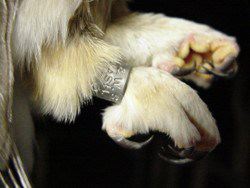
 and banded under permit and according to procedures prescribed by the federal Bird Banding Laboratory (BBL) and the ad hoc North American Banding Council (NABC); safely held for short periods for discussion and exhibition to various audiences; photographed (if desired); and released unharmed. Data collected during the banding process are maintained in the Center's education department, become part of the Center's permanent research database, and are submitted for inclusion in the files of the BBL, a division of the U.S. Geological Survey in Laurel MD.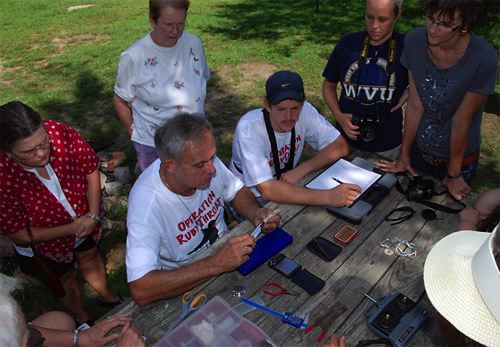
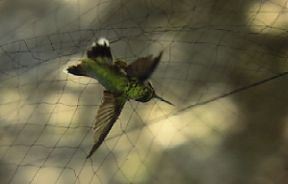 Nets are checked at least every 30 minutes (usually more often) and are not deployed at night (except for owl banding) or during inclement weather when conditions are likely to stress netted birds (e.g., temperatures below freezing, temperatures above 85° F.; moderate or heavy rain; cool and very windy days; or a combination of wet weather and cool temperatures). During educational banding programs, no more than a half dozen nets are deployed. In the unlikely event of a "fall-out" in which many birds hit the nets in a short time period, birds are quickly extracted and released without banding so that some or all nets can be closed. Neither traps or nets are deployed unless the operator remains close enough to make checks at appropriate intervals, and nets typically are in direct view of the bander. Traps or nets deployed in areas normally accessible and visible to the public are attended at all times by the bander or an experienced individual.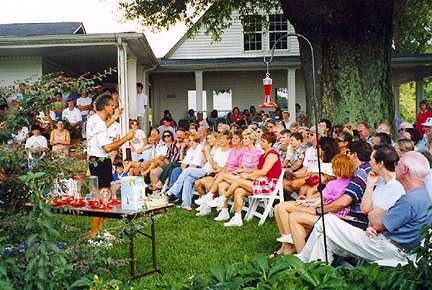
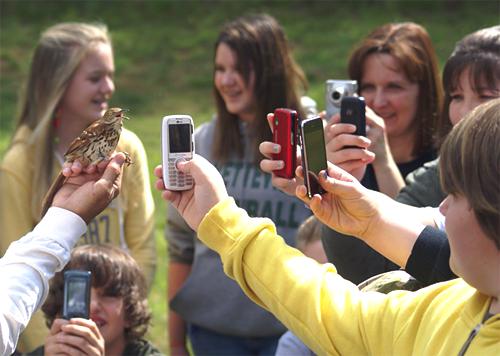
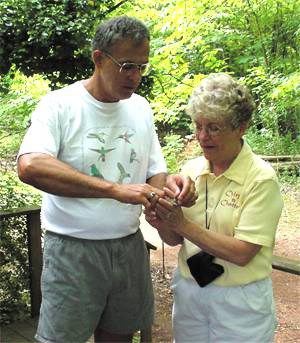 In some advanced adult workshops, the bander may teach participants how to extricate captures from traps but not from nets--and only under direct supervision. All banding is done exclusively by trained and authorized personnel. Some birds (especially large raptors or other birds with strong bills or talons) are released only by trained personnel, while others (especially passerines and hummingbirds) may be held, measured, and released by participants. Such releases are under direct supervision by and at the discretion of the bander, and only occur after thorough and proper instructions for holding and release are provided. Soap and water and/or sanitizer are provided so that participants may clean their hands after birds are released. Program participants are encouraged to take bird-in-the-hand photographs quickly and quietly and without using camera flash.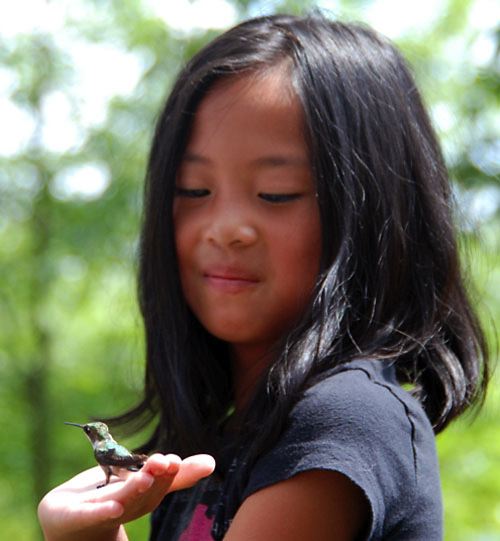

 Hilton Pond Center for Piedmont Natural History is a non-profit research & education organization in York, South Carolina USA; phone (803) 684-5852. Directed by