 HOME: www.hiltonpond.org |
|||
- RESEARCH -
SCHWEINITZ'S SUNFLOWER
RECOVERY
(updated 22 Oct 2013)
All text and photos © Hilton Pond Center
|
HOME: www.hiltonpond.org |
|||
- RESEARCH -
SCHWEINITZ'S SUNFLOWER
RECOVERY
(updated 22 Oct 2013)
All text and photos © Hilton Pond Center
|
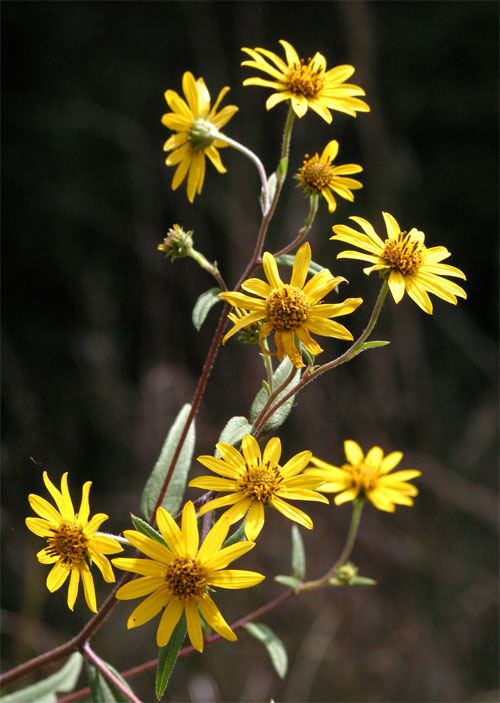
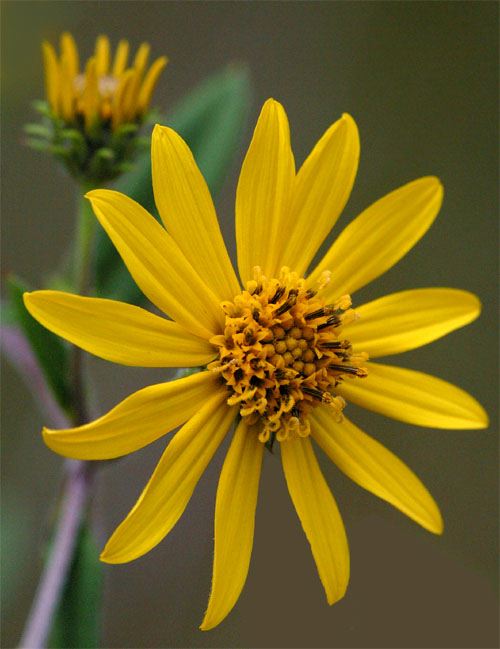
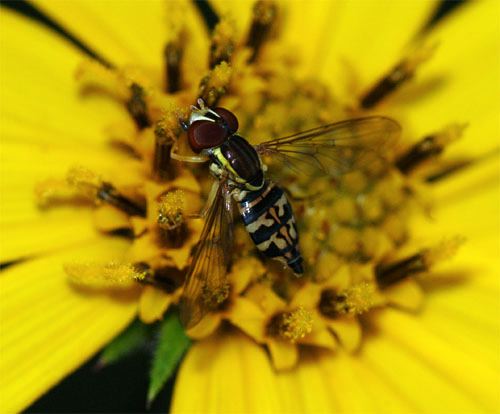
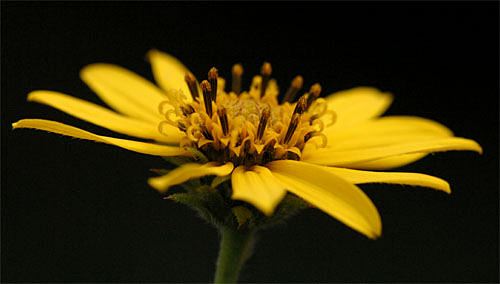
Although it is commonly believed the entire Carolina Piedmont was densely forested prior to the coming of Europeans, the region actually included large expanses of native Piedmont Prairie, especially within 100 km of present-day Charlotte NC. Such grassy savannas--open plains dotted with occasional trees and shrubs--contained many plants similar to but distinct from flora found in the tallgrass and shortgrass prairies of the midwestern United States. One Piedmont prairie species--Schweinitz's Sunflower, Helianthus schweinitzii (above)--is a perennial wildflower that persists today in a very few prairie remnants and along utility and highway rights-of-way. There are only about 90 known populations, many containing less than 40 plants each. Because of its scarcity, Schweinitz's Sunflower has been placed on the Endangered Species List and is fully protected by state and federal laws.
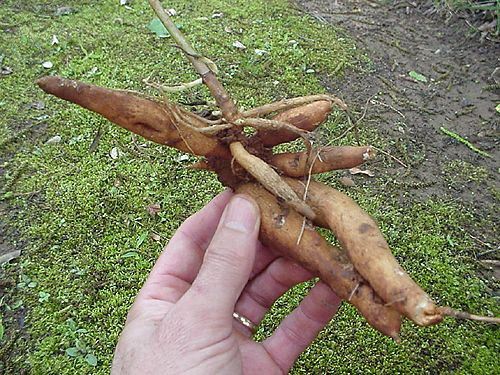
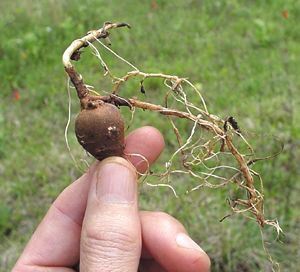
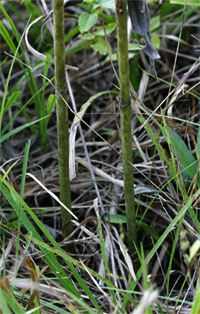
All text and photos © Hilton Pond Center To keep Schweinitz's Sunflower from becoming extinct, several conservation groups, government agencies, and individuals explore likely habitats to find and protect local populations of the plant. Sometimes seeds are collected in autumn and sown the next spring in appropriate nearby locations. Workers are also reclaiming new-growth woodlands and restoring them as prairie habitats in which the sunflower can be re-established. Hilton Pond Center for Piedmont Natural History became part of the education efforts of the Schweinitz's Sunflower Recovery Program when it received 30 sunflower roots of various sizes--some quite small--from Dr. Richard Houk, a retired botany professor from Winthrop University who is a noted authority on Schweinitz's Sunflower. Dr. Houk collected these roots (see two photos above) from a site along a York County highway not far from the Center. On 3 May 2002, staff from Hilton Pond Center dug shallow holes and planted the sunflower roots in a meadow-like area maintained until the mid-1990's by occasional early spring burning and now kept open by biannual light mowing in winter (see photo below, in which plantings are marked with red flags). It was anticipated the sunflowers would thrive in this "artificial prairie" and develop into a protected population with its own genetic diversity.
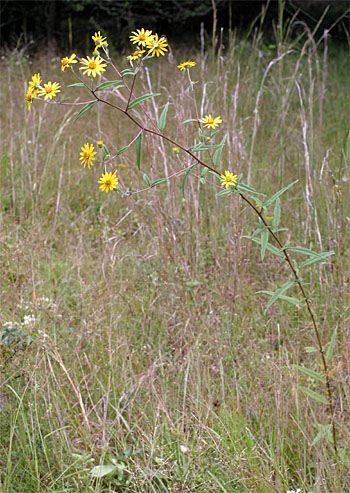
All text and photos © Hilton Pond Center Unfortunately, the initial effort met with disaster when White-tailed Deer apparently entered the meadow within a few days after the sunflowers were transplanted. As far as we could determined, deer pawed up the loose soil, ate nearly all the tuberous roots, and decimated the sunflower plantings. A few roots remained and were watched closely throughout the remainder of 2002. Although some vegetative growth did occur that year and in the one following, no blooms were produced until mid-September 2004 when Hilton Pond Center staff were elated--and relieved--to finally find a single seven-foot-tall stalk bearing more than 15 flower heads. Since these blossoms were attracting pollinators such as wasps, beetles, and small bees, it was anticipated they eventually would set seed and help expand the local population. Curiously, our one remining plant did not appear in 2005 and we feared it, too, had been destroyed by deer or other herbivores. Then, in fall 2006, we discovered the original tuber had given rise to TWO flower stalks (above left), both of which bore blooms into October. We were concerned when the plant did not flower in 2008 because deer browsed its foliage to the ground but were pleased in autumn 2009 after the rhizome produced SIX vertical stems. All text and photos © Hilton Pond Center
All contributions are tax-deductible on your SCHWEINITZ'S SUNFLOWER FACTS All text and photos © Hilton Pond Center
All text and photos © Hilton Pond Center
All text and photos © Hilton Pond Center
All text and photos © Hilton Pond Center
All text and photos © Hilton Pond Center For updates on the progress of the Center's specimen of Schweinitz's Sunflower, please see the following archived edition(s) of "This Week at Hilton Pond": Schweinitz's Sunflower: Endangered Species Revisited (11-20 Oct 2013) Back to Top of Page Back to Other Research This Week at Hilton Pond |
If you enjoy "This Week at Hilton Pond," please help support Hilton Pond Center for Piedmont Natural History. It's painless, and YOU can make a difference! (Just CLICK on a logo below or send a check if you like; see Support for address.) |
|
Make credit card donations on-line via Network for Good: |
 |
Use your PayPal account to make direct donations: |
|
If you like shopping on-line please become a member of iGive, through which 1,200+ on-line stores from Amazon to Lands' End and even iTunes donate a percentage of your purchase price to support Hilton Pond Center.  Every new member who registers with iGive and makes a purchase through them earns an ADDITIONAL $5 for the Center. You can even do Web searches through iGive and earn a penny per search--sometimes TWO--for the cause! Please enroll by going to the iGive Web site. It's a painless, important way for YOU to support our on-going work in conservation, education, and research. Add the iGive Toolbar to your browser and register Operation RubyThroat as your preferred charity to make it even easier to help Hilton Pond Center when you shop. Every new member who registers with iGive and makes a purchase through them earns an ADDITIONAL $5 for the Center. You can even do Web searches through iGive and earn a penny per search--sometimes TWO--for the cause! Please enroll by going to the iGive Web site. It's a painless, important way for YOU to support our on-going work in conservation, education, and research. Add the iGive Toolbar to your browser and register Operation RubyThroat as your preferred charity to make it even easier to help Hilton Pond Center when you shop. |
|
 post questions for The Piedmont Naturalist |
Join the |
Search Engine for |
|
|
 Still other folks monitor existing sunflower populations and move them if threatened by mowing, road construction, or other development.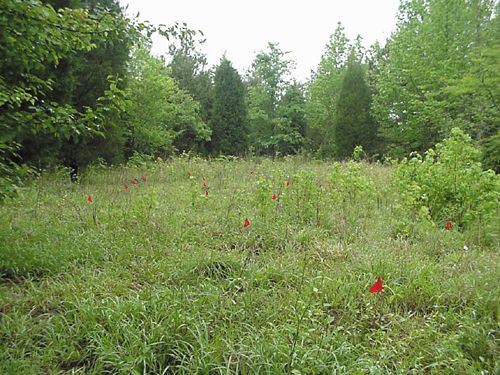
 If additional roots are planted at the Center, they will be covered by wire mesh to deter deer or other foraging animals.
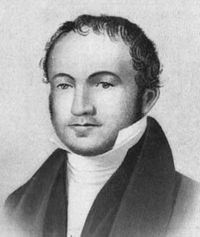 Classified in the Sunflower Family (Asteraceae, formerly Compositae)
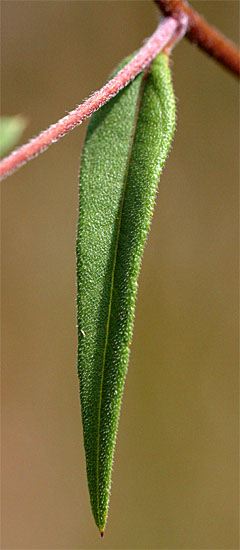 Thick, stiff leaves (right) are lanceolate (wider at base) and with smooth or slightly serrated edges; as season progresses, leaf edges are often made ragged by grazing insects

 Known today from only about 90 native populations in North Carolina (Anson, Cabarrus, Davidson, Gaston, Mecklenburg, Montgomery, Randolph, Rowan, Stanly & Union counties) and South Carolina (Lancaster & York counties); botanists are actively seeking to identify and protect other colonies in these and neighboring counties
 Populations are also endangered by residential and commercial development, and by invasive exotic plants such as Chinese Privet (Ligustrum sinensis), Russian Olive (Eleagnus angustifolia), Japanese Honeysuckle (Lonicera japonica), Kudzu (Pueraria montana lobata), etc.

 Hilton Pond Center for Piedmont Natural History is a non-profit research & education organization in York, South Carolina USA; phone (803) 684-5852. Directed by