|
|
|||

|
THIS WEEK at HILTON POND Installment #---Visitor # (Back to Preceding Week; on to Next Week) |
|
All maps, text & photos © Hilton Pond Center Comments or questions about this week's installment?
Thanks to the following fine folks for recent gifts in support of Hilton Pond Center for Piedmont Natural History and/or Operation RubyThroat: The Hummingbird Project. Your tax-deductible contributions allow us to continue writing, photographing, and sharing "This Week at Hilton Pond." (Please see Support if you'd like to make a gift of your own. You can also contribute by ordering an Operation RubyThroat T-shirt.)
"This Week at Hilton Pond" is written & photographed You may wish to consult our Index of all nature topics covered since February 2000. You can also use our on-line Hilton Pond Search Engine at the bottom of this page. For a free, non-fattening, on-line subscription to |
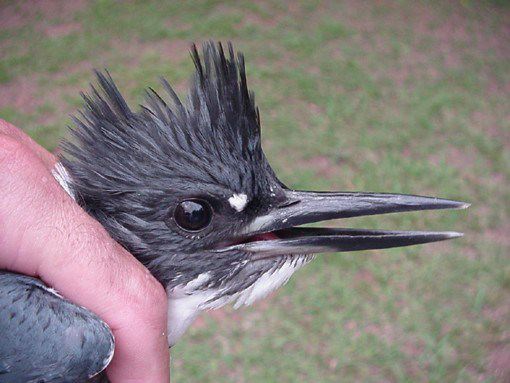
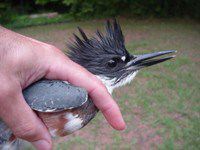 The Belted Kingfisher is the only kingfisher in the eastern United States. It is a crested, blue-backed bird with a blue belly band that gives it its common name. Unlike most birds, the female Belted Kingfisher (right) is more brightly colored than the male; a second rust-colored belly band parallels the blue one on her breast. Kingfishers are also unusual in that they burrow several feet into earthen embankments and excavate a nest chamber that is bound to be odoriferous from all the fish adults bring the young.
 Be sure to scroll down for an account of all
|
Make direct donations on-line via
Network for Good: |
 |
|
Use your PayPal account
to make direct donations: |
|
 If you like to shop on-line please become a member of iGive, through which more than 750 on-line stores from Amazon to Barnes & Noble, L.L. Bean to Lands' End--and even iTunes!--will donate a percentage of your purchase price in support of Hilton Pond Center and Operation RubyThroat. For every new member who signs up and makes an on-line purchase iGive will donate an ADDITIONAL $5 to the Center. You can even do Web searches through iGive and earn a penny per search for the cause! Please enroll by going to the iGive Web site; more than 200 members have signed up to help. It's a painless, important way for YOU to support our on-going work in conservation, education, and research. By the way, if you add the iGive Toolbar to your browser and register Operation RubyThroat as your preferred charity, it'll be even easier to help Hilton Pond when you shop. |
|
|
|
|
|
Plus the following species not pictured Acadian Flycatcher |
All text & photos © Hilton Pond Center This Week at Hilton Pond |



 Hilton Pond Center for Piedmont Natural History is a non-profit research & education organization in York, South Carolina USA; phone (803) 684-5852. Directed by