HOME: www.hiltonpond.org |
|||

|
THIS WEEK at HILTON POND 1-7 September 2000 Installment #34--Visitor # (Back to Preceding Week; on to Next Week) |
|
All text & photos © Hilton Pond Center There's something about Eastern Box Turtles that makes a person smile. Perhaps it's because they're so different from most animals as they wander the woods, homeless but also carrying all the shelter they'll ever need. Or maybe its because this is a creature that can pull in its head, legs, and tail and close up its shell, withdrawing completely from the outside world.
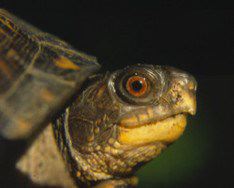 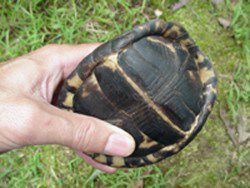
All text & photos © Hilton Pond Center Most of our local Box Turtles continue to nibble on mushrooms or blackberries when we pass, but a few are so skittish they always withdraw at least part way into their shells. This is facilitated by a plastron that has a cartilaginous hinge (above right). In particularly good blackberry years, Box Turtles go into a slow-motion feeding frenzy and gorge themselves so heavily they can't close their shells completely. This doesn't seem like good survival strategy, but we'll bet the well-fed turtles with blackberry-stained faces or fat rolls around their legs could care less--and that's another thing about Box Turtles that makes people smile. All text & photos © Hilton Pond Center
All contributions are tax-deductible |
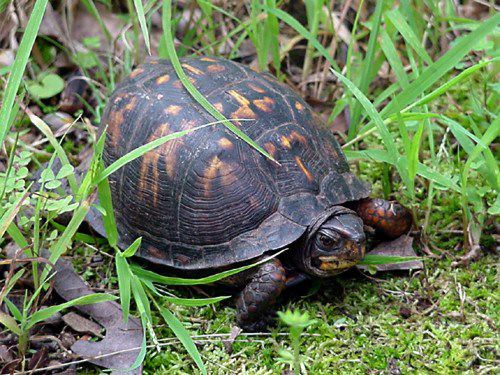
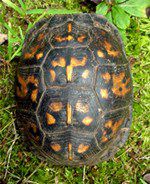 We frequently encounter Eastern Box Turtles (Terrapene carolina) on trails at Hilton Pond Center, and some individuals are easily recognized by their unique appearances. Most have shells with chips or scratches that are evidence of some mysterious incident from long ago; a straight two-inch shell gash on one lucky-to-still-be-alive turtle probably was caused by a mower blade. Each Box Turtle also has distinctive markings on its upper shell, or carapace. Often these are wide splotches of orange (right), but sometimes the markings are fine star bursts of yellow that contrast sharply against a dull brown background.
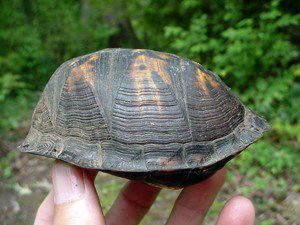 Not only are individual turtles identifiable, but we can even determine the sex of each in one of three ways. A side view of the female's carapace shows it is squared off at the back (left), while a male has a sloped carapace; the angular shape of the female's shell provides room inside where eggs can develop. Box Turtle plastrons (bottom shells) also show sexual differences. The male's plaston has a shallow central depression into which the female's carapace fits when he mounts her from the rear to mate, while a female's plastron is undimpled--again allowing added space for eggs. The final clue to a Box Turtle's sex is its eye color; males have irises with at least some bright red color (below left), while females have yellow, orange, or brown eyes.
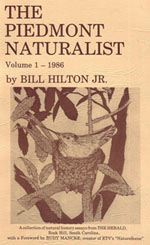 The Piedmont Naturalist, Volume 1 (1986)--long out-of-print--has been re-published by author Bill Hilton Jr. as an e-Book downloadable to read on your iPad, iPhone, Nook, Kindle, or desktop computer. Click on the image at left for information about ordering. All proceeds benefit education, research, and conservation work of Hilton Pond Center for Piedmont Natural History. The Piedmont Naturalist, Volume 1 (1986)--long out-of-print--has been re-published by author Bill Hilton Jr. as an e-Book downloadable to read on your iPad, iPhone, Nook, Kindle, or desktop computer. Click on the image at left for information about ordering. All proceeds benefit education, research, and conservation work of Hilton Pond Center for Piedmont Natural History. |
|
"This Week at Hilton Pond" is written and photographed by Bill Hilton Jr., executive director of Hilton Pond Center for Piedmont Natural History |
|
Please refer "This Week at Hilton Pond" to others by clicking on this button: |
 Comments or questions about this week's installment? Send an E-mail to INFO. (Be sure to scroll down for a tally of birds banded/recaptured during the period, plus other nature notes.) |
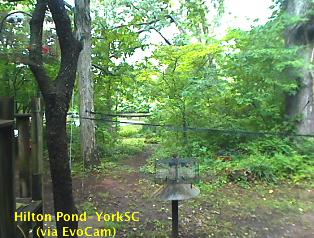
Click on image at right for live Web cam of Hilton Pond,
plus daily weather summary
Transmission of weather data from Hilton Pond Center via WeatherSnoopfor Mac.
--SEARCH OUR SITE-- For a free on-line subscription to "This Week at Hilton Pond," send us an |
Thanks to the following fine folks for recent gifts in support of Hilton Pond Center for Piedmont Natural History and/or Operation RubyThroat: The Hummingbird Project. Your tax-deductible contributions allow us to continue writing, photographing, and sharing "This Week at Hilton Pond" with students, teachers, and the general public. Please see Support or look below if you'd like to make a gift of your own.
|

If you enjoy "This Week at Hilton Pond," please help support Hilton Pond Center for Piedmont Natural History. It's painless, and YOU can make a difference! (Just CLICK on a logo below or send a check if you like; see Support for address.) |
|
Make credit card donations on-line via Network for Good: |
 |
Use your PayPal account to make direct donations: |
|
If you like shopping on-line please become a member of iGive, through which 950+ on-line stores from Amazon to Lands' End and even iTunes donate a percentage of your purchase price to support Hilton Pond Center.  Every new member who registers with iGive and makes a purchase through them earns an ADDITIONAL $5 for the Center. You can even do Web searches through iGive and earn a penny per search--sometimes TWO--for the cause! Please enroll by going to the iGive Web site. It's a painless, important way for YOU to support our on-going work in conservation, education, and research. Add the iGive Toolbar to your browser and register Operation RubyThroat as your preferred charity to make it even easier to help Hilton Pond Center when you shop. Every new member who registers with iGive and makes a purchase through them earns an ADDITIONAL $5 for the Center. You can even do Web searches through iGive and earn a penny per search--sometimes TWO--for the cause! Please enroll by going to the iGive Web site. It's a painless, important way for YOU to support our on-going work in conservation, education, and research. Add the iGive Toolbar to your browser and register Operation RubyThroat as your preferred charity to make it even easier to help Hilton Pond Center when you shop. |
|