 HOME: www.hiltonpond.org |
|||
|
THIS WEEK at HILTON POND Installment #68---Visitor # (Back to Preceding Week; on to Next Week) |
|
TAMING OF THE Among the most elusive of all our small mammals at Hilton Pond Center are the shrews--tiny, scurrying creatures with frenetic lifestyles and secretive habits. For many people, their only encounters with shrews come when a destructive House Cat drags one onto the front stoop and leaves it as a a symbol of wildlife-killing prowess. A cat doesn't usually eat the shrew, which is understandable; if shrews taste as bad as some of them smell, they'd probably cause more gagging than a furball. 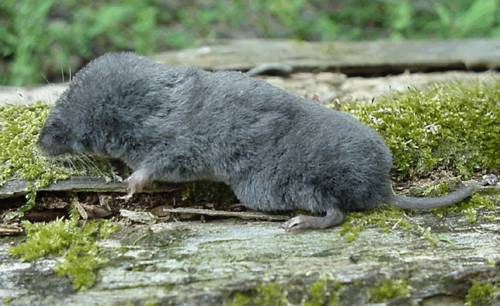
All text & photos © Hilton Pond Center At Hilton Pond Center, our most common shrew is the 3.5"-long Blarina carolinensis, the Southern Short-tailed Shrew. This species occurs throughout the southeastern and south central U.S. as far north as southern Illinois, except for mountain regions. It is often confused with the somewhat larger Northern Short-tailed Shrew, B. brevicauda, similar in appearance. Both species have tiny eyes and ears hidden by soft, velvety gray fur that has no nap; it folds forward or backward, allowing easy movement in and out of tight spots. The tail is lightly furred and about twice the length of the hind foot, but much shorter than the cylindrical body. Paired glands on the flanks and rump secrete a strong odor that apparently is used to to communicate with other shrews. Short-tailed shrews are "habitat generalists" that scurry across the substrate, exploring every nook and cranny; they can be found in almost any type of vegetation--even areas disturbed by clear-cutting and mining--so long as it is not too wet and there is sufficient ground cover to protect the shrews from predators. Shrews have the highest metabolisms of any North American mammal and, as such, are reported to eat their own weight in food each day. They chase down insects, centipedes, spiders, earthworms, salamanders, and even mice that are twice the shrew's size. Short-tailed Shrews construct surface runways that zigzag through leaf litter and herbaceous vegetation, but they also use their snouts and forefeet to dig tunnels a foot or more deep. Both Blarina spp. are somewhat gregarious, with conspecifics often using a common burrow system. In B. carolinensis, a pair may stay together between litters, which come at the rate of every 60 days or so from early spring through late fall. The young develop slowly for small mammals, their eyes not opening for three weeks or more.
Despite Shakespeare's contention, it's unlikely that Southern Short-tailed shrews can actually be tamed. Besides, their musky odor, sharp teeth, and brief lifespans (two-years max) probably wouldn't make them very good pets. At Hilton Pond Center, we're content to let shrews go about their business as the smallest, most ferocious predators stalking our woods. Comments or questions about this week's installment?
Thanks to the following fine folks for recent gifts in support of Hilton Pond Center for Piedmont Natural History and/or Operation RubyThroat: The Hummingbird Project. Your tax-deductible contributions allow us to continue writing, photographing, and sharing "This Week at Hilton Pond." (Please see Support if you'd like to make a gift of your own. You can also contribute by ordering an Operation RubyThroat T-shirt.)
"This Week at Hilton Pond" is written & photographed You may wish to consult our Index of all nature topics covered since February 2000. You can also use our on-line Hilton Pond Search Engine at the bottom of this page. For a free, non-fattening, on-line subscription to |
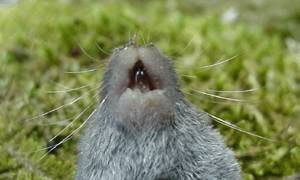 All shrews are classified as Insectivora--the order that includes moles--and have 32 tiny, mostly pointed teeth that quickly subdue prey. Surprisingly, however, up to 20% of a shrew's diet may be nuts and berries. The distinctive reddish-brown color of the incisor tips (above left) makes it easy to identify a shrew skull. Short-tailed Shrews produce a toxic saliva that paralyzes but doesn't necessarily kill prey animals, which they may store for future use; land snails are suspected to be a main component of the winter larder. Although shrew venom is commonly said to be dangerous to humans, there is no strong medical evidence to support this conjecture.
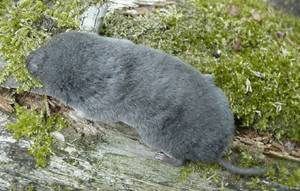 Since each pair annually may produce three or four litters of 5-7 pups each, and since females weaned early in the season may breed before winter comes, tremendous numbers of Southern Short-tailed Shrews are produced each year. Such fecundity leads to a wide variety of animals that eat shrews, and they are a staple for snake, hawk, weasel, fox, and skunk. Shrews also frequently show up in owl pellets--which makes sense because both owl and shrew are primarily nocturnal.
 Be sure to scroll down for an account of all
|
Make direct donations on-line via
Network for Good: |
 |
|
Use your PayPal account
to make direct donations: |
|
 If you like to shop on-line, you please become a member of iGive, through which more than 750 on-line stores from Barnes & Noble to Lands' End will donate a percentage of your purchase price in support of Hilton Pond Center and Operation RubyThroat. For every new member who signs up and makes an on-line purchase iGive will donate an ADDITIONAL $5 to the Center. Please sign up by going to the iGive Web site; more than 200 members have signed up to help. It's a painless, important way for YOU to support our on-going work in conservation, education, and research. |
|


 Hilton Pond Center for Piedmont Natural History is a non-profit research & education organization in York, South Carolina USA; phone (803) 684-5852. Directed by