|
|
|||

|
THIS WEEK at HILTON POND
Installment #73---Visitor # (Back to Preceding Week; on to Next Week) |
|
HERE'S "LOOKING" AT YOU: Sometimes when we go to the woods around Hilton Pond Center, we get the eerie feeling that someone--or something--is watching US while we're watching nature. Occasionally, however, the beady little eyes that are staring at us aren't eyes after all--as is the case with the Eyed Click Beetle, Alaus oculatus. 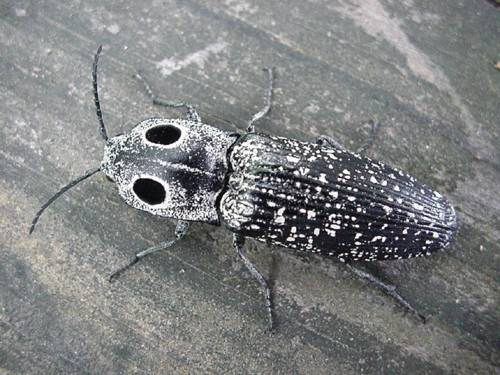
All text & photos © Hilton Pond Center Nearly two inches long and found across the eastern U.S. as far west as Texas, this formally attired gray and black and white insect is one of the largest members of the Click Beetle Family (Elateridae); the huge eyespots on its pronotum make it one of the most easily identified. These are "false eyes," of course--likely an adaptation to scare off potential predators. The true eyes of the Eyed Click Beetle are much smaller and located at the bases of its heavily sawtoothed antennae (below left).
Despite their differences in appearance, all Click Beetles have a startling behavior that demonstrates how they got their primary name--as well as the alternate epithets of "snapping beetle," "skipjack," and "spring beetle." When placed on its back--or when grabbed by an insectivore--a Click Beetle bends its head and prothorax backward and then straightens out suddenly with a snapping motion; this results in an audible click and launches the beetle several inches into the air. This stunt is facilitated by a spine on the underside of the prosternum that fits into a groove in the mesosternum (below).
All text & photos © Hilton Pond Center Occasionally, a Click Beetle will take flight during its midair maneuver, but more often it simply falls back to earth. If it lands on its back the beetle may "click" again, or it may tightly tuck its legs and antennae and "play possum" until the predator loses interest. Eventually, it will wander off, perhaps looking for a little sustenance (flower nectar or leaf sap) or a mate. Click Beetles--like bees, ants, butterflies, and some other insect orders--undergo a four-stage (complete) metamorphosis that includes the egg, larva (AKA "grub"), pupa, and adult. We don't grow any of these plants at Hilton Pond Center, of course, but we do have plenty of old wood and wood-boring insects, so we're content to let our local wireworms go about their subterranean business and, as they mature, to delight us with the acrobatic antics of adult Eyed Click Beetles. All text & photos © Hilton Pond Center
All contributions are tax-deductible Comments or questions about this week's installment?
Thanks to the following fine folks for recent gifts in support of Hilton Pond Center for Piedmont Natural History and/or Operation RubyThroat: The Hummingbird Project. Your tax-deductible contributions allow us to continue writing, photographing, and sharing "This Week at Hilton Pond." (Please see Support if you'd like to make a gift of your own. You can also contribute by ordering an Operation RubyThroat T-shirt.)
"This Week at Hilton Pond" is written & photographed You may wish to consult our Index of all nature topics covered since February 2000. You can also use our on-line Hilton Pond Search Engine at the bottom of this page. For a free, non-fattening, on-line subscription to |
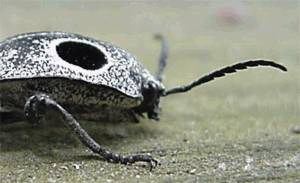 Few of the 800 or so species of Click Beetles in North America are as dramatically adorned as the Eyed Click Beetle. Most are considerably smaller (a half-inch long or less) and without distinctive markings. Several uniformly brown or black species frequently are seen around porch lights at night.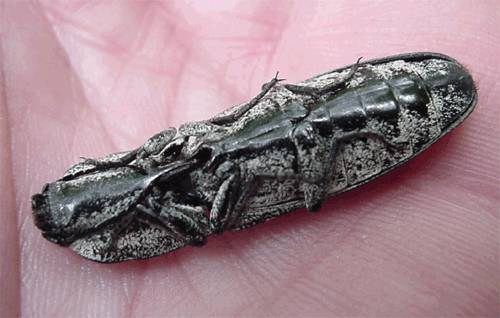
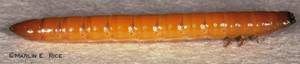 Although adults are harmless, Click Beetle larvae cause significant agricultural and horticultural damage. Click Beetle grubs--also known as "wireworms" because of their elongated shape and hard exoskeletons (above right)--live in soil or dead wood for two to ten years, depending on the species. During that time, they are predatory on other wood-borng insects. Most other wireworm species, by comparison, chow down on roots and stems-- including those attached to corn, potatoes, tobacco, turf grasses, garden ornamentals, and a variety of legumes.
 Be sure to scroll down for an account of all
|
Make direct donations on-line via
Network for Good: |
 |
|
Use your PayPal account
to make direct donations: |
|
 If you like to shop on-line please become a member of iGive, through which more than 750 on-line stores from Amazon to Barnes & Noble, L.L. Bean to Lands' End--and even iTunes!--will donate a percentage of your purchase price in support of Hilton Pond Center and Operation RubyThroat. For every new member who signs up and makes an on-line purchase iGive will donate an ADDITIONAL $5 to the Center. You can even do Web searches through iGive and earn a penny per search for the cause! Please enroll by going to the iGive Web site; more than 200 members have signed up to help. It's a painless, important way for YOU to support our on-going work in conservation, education, and research. By the way, if you add the iGive Toolbar to your browser and register Operation RubyThroat as your preferred charity, it'll be even easier to help Hilton Pond when you shop. |
|



 Hilton Pond Center for Piedmont Natural History is a non-profit research & education organization in York, South Carolina USA; phone (803) 684-5852. Directed by