HOME: www.hiltonpond.org |
|||

|
THIS WEEK at HILTON POND Installment #118---Visitor # Back to Preceding Week; on to Next Week |
PIPEORGAN MUD DAUBERS Because Eastern Bluebirds begin breeding as early as 1 March in some parts of the country, at Hilton Pond Center we're in the habit of advising folks to clean their nestboxes by Valentine's Day, 14 February. We try to follow our own advice--except when a bluebird box is occupied by a Southern Flying Squirrel feamle with pups; when this happens, we're inclined to wait a few weeks until the young have been weaned and the whole family is out gliding from tree to tree. After that, however, we toss out the mass of Eastern Red Cedar bark strips that kept the squirrels comfy--in the hope bluebirds will move in and raise a brood or two of their own. 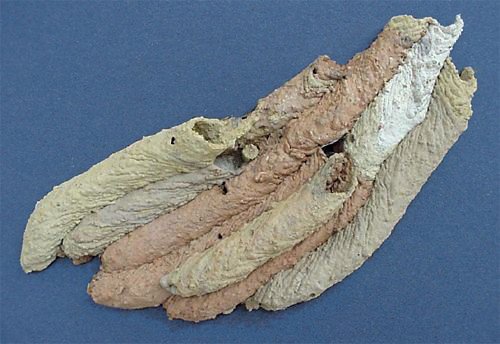 All text & photos © Hilton Pond Center That was the scenario earlier this spring that kept us from evicting a mother squirrel and her litter from an oft-used nestbox on the Center's southern boundary. Our flying squirrels finally departed this week, so we re-scheduled maintenance duties--only to find that the box also contained old nests of a whole bevy of Mud Dauber Wasps. We carefully pried one nest cluster from the box and brought it back to the lab to examine it more closely.
All text & photos © Hilton Pond Center Several kinds of mud-collecting insects occur in the U.S. but the distinctive structures made by our specimen indicated it was an Organpipe Mud Dauber Wasp, named for its long, half-inch-wide nest tubes. These wasps, probably Trypoxylon politum in our case, are common in the eastern U.S., where they are also called "Dirt Daubers." Unlike highly social Paper Wasps that have worker castes--and some of which collaborate to build large conical structures known as "hornet's nests"--Organpipe Mud Daubers are solitary, with a female building one tube at a time, sometimes while the male stands guard. As prerequisite, the female Mud Dauber wasp finds a site with a supply of moist soil--
Since we wanted to know more about the mud tubes from the bluebird box at Hilton Pond Center, we decided to dissect them to see just what they contained. We came up with some amazing discoveries. To begin with, there were ten distinct tubes in the cluster we collected, and it appeared they were made of mud from at least seven different sources. The most common substrate was to be expected--red Piedmont clay--but tan and even white mud were also used, and some of the tubes were more granular than others. Several--perhaps even ten--females may have been involved in the construction of the ten pipes, but that's only speculation.
Incredibly, only four of the 30 chambers contained full-sized Mud Dauber Wasp cocoons. Producing only four potentially viable offspring in 30 chambers is not a very high rate of success for these female Organpipe Mud Dauber Wasps that spent untold hours carrying uncounted little balls of mud to construct their multiple nest chambers. Despite hard work, however, the Mud Daubers at Hilton Pond Center had the odds against them from the start. It's not that the female wasps forgot to lay eggs or didn't collect enough spiders, it's that other organisms are adapted to compete directly with the Mud Daubers adults or their larvae.
Curiously, some of the chambers of the Organpipe Mud Dauber Wasps even had tan-colored subchambers within them (below right). When we opened these, they contained small (quarter-inch) yellow pupae, but we're not sure whether these were merely "squatters" in the Mud Dauber nests or if they, too, were potential kleptoparasites or predators. (One source suggests they are the work of the Mud Daubing Spider Wasp, Auplopus mellipes.)
Indeed, Organpipe Mud Dauber Wasps are fascinating little creatures worth saving. Herein we have photographed and presented about every aspect of their life history except an actual egg and the wasp that produces it, but we're confident we'll soon have a photo of an adult. There are still three viable young left from our examination of the Mud Dauber nests from the Hilton Pond Center bluebird box, so we put the cocoons in a jar outside our window and will keep an eye on them to see when they expupate. When that happens, we'll let you know what the adults look like--as well as whether these solitary wasps really WILL fail to sting us when we put the camera lens up close to their beady little compound eyes. All text & photos © Hilton Pond Center
All contributions are tax-deductible
Thanks to the following fine folks for recent gifts in support of Hilton Pond Center for Piedmont Natural History and/or Operation RubyThroat: The Hummingbird Project. Your tax-deductible contributions allow us to continue writing, photographing, and sharing "This Week at Hilton Pond." (Please see Support if you'd like to make a gift of your own. You can also contribute by ordering an Operation RubyThroat T-shirt.)
|
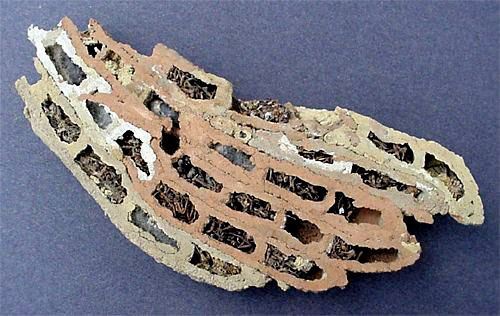
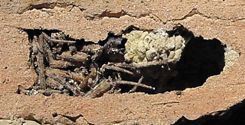
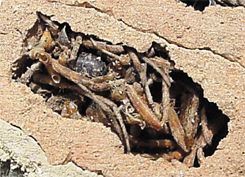 usually something that is clay-based--and uses her mandibles to roll a small ball of mud she carries back to the nest site. She smashes one mud ball against another with her mouth and forehead until a short tube is formed and then becomes a huntress--wandering far and wide until she locates an appropriately sized spider to her liking. She stings the spider--paralyzing but not killing it--and returns with it to her nest, where she slides the freshly immobilized prey into the clay tube. After gathering several spiders--whose jumbled legs are obvious in most of the chambers (above right)--she lays a single egg on one of them and seals off the end of the tube with a cross-wall of mud. Then she extends the tube and repeats the process over and over again, sometimes creating a half dozen or more chambers before leaving, perhaps to start a new "pipe" in another location.
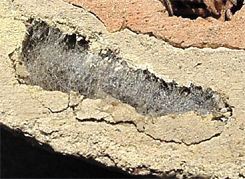 As each wasp egg hatches, the new larva begins consuming the soft parts of spiders in its respective natal chamber until the larder is used up, after which the larva forms and overwinters in an inch-long cocoon surrounded by a silk cocoon (left and below right). By early summer, the new wasp breaks out of the case and chews its way through the mud wall of its chamber, eventually flying off to find a sexually compatible Organpipe Mud Dauber with which it can start the whole cycle over.
 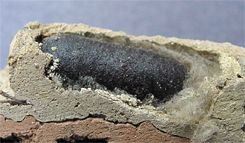 It's then that folks frequently see these wasps building mud-colored organpipes on house chimneys, inside light fixtures, under porch furniture, on attic rafters, between stacked boards, on parked vehicles, and in birdhouses--virtually anyplace that's out of the rain.
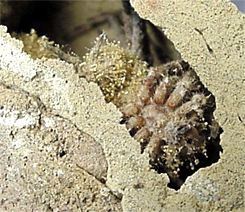 The longest tube had six chambers, and the shortest only two, with a total of about 30 cells (we broke a couple when we collected the cluster). One chamber appeared to be empty, but the rest had an interesting assortment of contents. Each contained between one and four spiders--all of which seemed to be the same species of Orb-Weaver (Araneidae); when alive, each spider would have had an abdomen about three-eighths of an inch in diameter, with each leg about three-quarters of an inch long, so these were sizable prey items. Several chambers contained just spiders, suggesting that the Mud Dauber Wasp either laid an infertile egg or produced a larva that died very early after hatching. And a couple of the spiders-only cells contained dead spiders with a yellow-white fungus growing on their abdomens (above left)--indicating they finally died within the nest tube but weren't eaten at all.
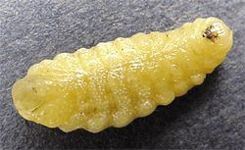 We opened one and found a yellow grub inside (below right)--the as-yet-undeveloped larval stage of the wasp. The grub's head is to the right in the photo, and dark spot is what will become the adult wasp's eyes, mouthparts, and legs. All the cocoons weighed about the same, so we assume they each contained viable larvae.
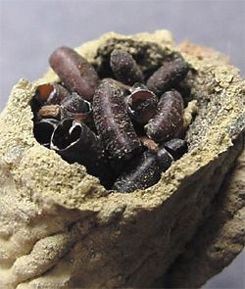 In nearly half the cells that contained no Mud Dauber larvae, we found small, empty brown cocoons (left) about a quarter-inch long. These were left behind by kleptoparasites--animals that "steal food." Several types of flies (Sarcophagids or Tachinids) or smaller wasps (Chrysidids) actually stalk a female Mud Dauber and wait for the wasp to provision a paralyzed spider in the nest and lay an egg, and then they quickly lay an egg of their own. The kleptoparasite's egg hatches in just a few days and its larva immediately "steals" (i.e., consumes) the spider--which means the later-hatching Mud Dauber grub starves, and may even get eaten by its chamber mate.
 This whole essay is just a convoluted way of saying there's nothing simple about Organpipe Mud Daubers or the variety of roles they play in nature. They obviously terminate lots of spiders, so if you're an arachnophobe you should admire and encourage them. As they search for spiders, these wasps also pollinate flowers, so wildflower enthusiasts will find a place in their hearts for Mud Daubers Wasps. And the really important thing to remember is that Organpipe Mud Daubers--although they may be visible and active in building nests right over your front door--are like the rest of the solitary wasps in that they almost never sting unless grabbed or seriously molested; this makes them very different from some of the social wasps (e.g., Yellow Jackets and White-faced Hornets) that may sting at the slightest provocation.

 The Piedmont Naturalist, Volume 1 (1986)--long out-of-print--has been re-published by author Bill Hilton Jr. as an e-Book downloadable to read on your iPad, iPhone, Nook, Kindle, or desktop computer. Click on the image at left for information about ordering. All proceeds benefit education, research, and conservation work of Hilton Pond Center for Piedmont Natural History. The Piedmont Naturalist, Volume 1 (1986)--long out-of-print--has been re-published by author Bill Hilton Jr. as an e-Book downloadable to read on your iPad, iPhone, Nook, Kindle, or desktop computer. Click on the image at left for information about ordering. All proceeds benefit education, research, and conservation work of Hilton Pond Center for Piedmont Natural History. |
|
"This Week at Hilton Pond" is written and photographed by Bill Hilton Jr., executive director of Hilton Pond Center for Piedmont Natural History |
|
Please refer "This Week at Hilton Pond" to others by clicking on this button: |
 Comments or questions about this week's installment? Send an E-mail to INFO. (Be sure to scroll down for a tally of birds banded/recaptured during the period, plus other nature notes.) |
Click on image at right for live Web cam of Hilton Pond,
plus daily weather summary
Transmission of weather data from Hilton Pond Center via WeatherSnoopfor Mac.
--SEARCH OUR SITE-- For a free on-line subscription to "This Week at Hilton Pond," send us an |



 Hilton Pond Center for Piedmont Natural History is a non-profit research & education organization in York, South Carolina USA; phone (803) 684-5852. Directed by