|
|
|||

|
THIS WEEK at HILTON POND Installment #145---Visitor # |
|
LONG LIVE THE KING(lets)! By now, most of our migratory summer birds have departed Hilton Pond Center for destinations in the Neotropics. Birds that eat free-flying insects--and those includes everything from Acadian Flycatchers to Ruby-throated Hummingbirds--would have a tough time in winter when cold weather drastically knocks back dependable populations of aerial bugs. These migrant birds depart for warmer climes, and a whole new crop of winter-tolerant species comes in from New England and Canada. The Center already is being graced by White-throated Sparrows, Yellow-bellied Sapsuckers, and Yellow-rumped Warblers, and each year by the third week in October such winter residents are joined by an assemblage of Royal Emissaries from far-off lands.
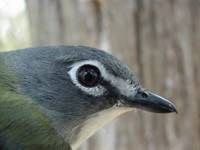
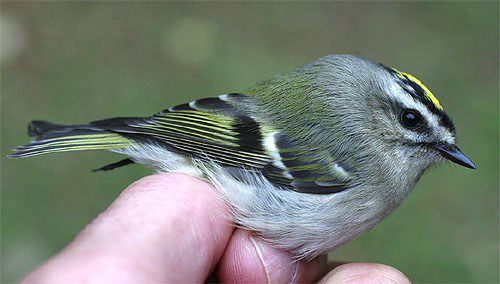
All text & photos © Hilton Pond Center This new entourage really IS a royal group--the Regulidae (from the Latin word rex, which means "king")--a family that includes two of the tiniest songbirds in North America: the Ruby-crowned Kinglet, Regulus calendula, and Golden-crowned Kinglet, R. satrapa. Historically, taxonomists lumped kinglets (Regulidae) with gnatcatchers (Sylviidae) and even the spot-breasted thrushes (Turdidae), but modern DNA work has separated them into three distinct families. No matter how you classify them, however, kinglets are delightful birds to watch because of their behavior and appearance. Golden-crowned Kinglets are most regal; both sexes bear a yellow crown trimmed with black stripes (female top and bottom photos), and the male has an additional top-knot of red-orange feathers (above right) that is sometimes hidden. In Ruby-crowned Kinglets, the female wears no tiara, but the male (next two photos below) has a scarlet spot atop his head that he reveals on appropriate occasions--including territorial disputes, mating opportunities, or even when another male gets too close on the wintering grounds.
All text & photos © Hilton Pond Center Golden-crowned Kinglets are quite tiny, measuring only 10cm (4") from bill tip to end of tail, and weighing a scant 6g (0.2 oz)--barely twice the mass of a Ruby-throated Hummingbird! Ruby-crowneds are a tad larger, weighing in at 6.5g and measuring 11cm. When temperatures get very low, both species may seem bigger when they fluff up their plumage and look like feathered spheres on a twig. Kinglets have been called "butterfly birds" because they flutter about in trees and shrubs, flicking their wings and hovering at the tips of branches where they use sharp, black bills to glean insects and spiders and their eggs.
All text & photos © Hilton Pond Center By next March, both kinds of kinglets will start making their way northward toward the breeding grounds. First to leave are the Golden-crowneds--some of which travel only as far as the southern Appalachians, with others going on to breed in Canada's boreal spruce-fir forests. We've had on occasional Ruby-crowned linger at Hilton Pond Center as late as 8 May, perhaps because the limits of its more northerly breeding grounds around Hudson Bay and in central Alaska were still too cold for egg-laying. Although Ruby-crowned and Golden-crowned Kinglets are at Hilton Pond Center for only part of the year, our drab winter days are certain to be brightened by their regal appearance and lively behavior. Long live the King(lets)! All text & photos © Hilton Pond Center
All contributions are tax-deductible on your |

 Unfortunately, some relatively recent field guides still describe a catch-all group of "Old World Warblers" that includes kinglets and gnatcatchers, but only the latter truly belong in that family. Better we should follow current scientific wisdom and place the kinglets alone in the Regulidae, lest we taint their "royal" bloodline.
 Golden-crowned Kinglets differ further in having a dark line through the eye, while Ruby-crowneds have a plain face and an incomplete white eye-ring that makes the eye appear larger than it is. Both species sport white wingbars and pale yellowish-green backs, but from below the brighter grayish flanks of the Golden-crowned are usually distinguishable from the Ruby-crowned's buffy-olive. Although Golden-crowned Kinglets seldom sing except on the breeding grounds, a Ruby-crowned occasionally blurts forth with his "liberty, liberty, liberty" in spring and fall migration. Kinglet vocalizations are so high-pitched that many people cannot hear them.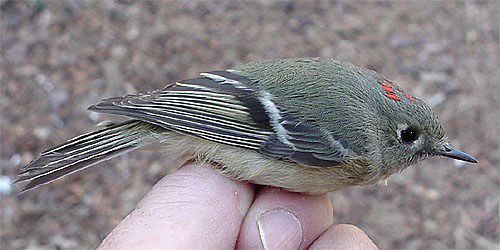
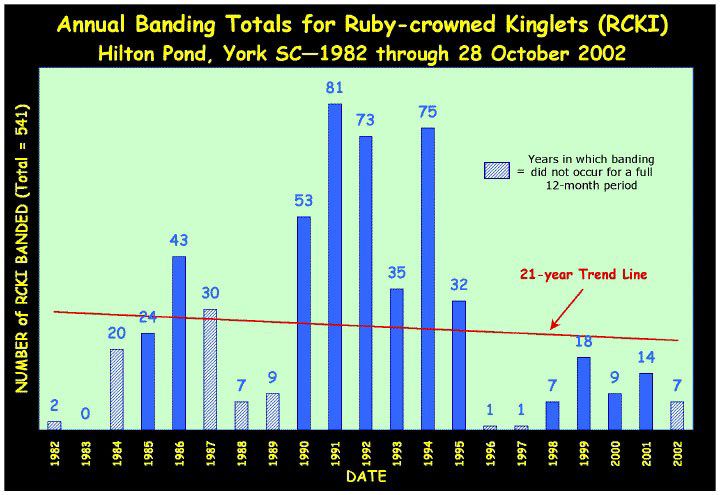

"This Week at Hilton Pond" is written and photographed by Bill Hilton Jr., executive director of Hilton Pond Center for Piedmont Natural History |
|
Please refer "This Week at Hilton Pond" to others by clicking on this button: |
 Comments or questions about this week's installment? Send an E-mail to INFO. (Be sure to scroll down for a tally of birds banded/recaptured during the period, plus other nature notes.) |