|
|
|||
|
|
|||
THIS WEEK at HILTON POND
15-21 February 2003
Installment #161---Visitor #
Subscribe for free to our award-winning nature newsletter
(Back to Preceding Week; on to Next Week)
|
NATURE'S SANITATION ENGINEERS Back in the 1980s and early 1990s, one of our favorite summer pastimes was to float lazily around on Hilton Pond, watching the aerobatic antics of subsets from a sizable local population of perhaps 200 Black Vultures and thrice that many Turkey Vultures. These big, dark birds would soar overhead, riding August thermals to effortlessly rise a thousand or more feet in a matter of seconds. The larger Turkey Vultures--their six-foot wingspans held in a slight V-shaped dihedral--always wobbled on the wind, while Black Vultures held their 4.5-foot wings in flat profile and seemed to cut through the air much more quickly.
All text, maps, charts & photos © Hilton Pond Center A decade ago, our vulture observations were facilitated by Hilton Pond Center's location about a mile or so from the York County landfill, a main roosting and foraging ground in the region for avian scavengers such as vultures and gulls. Today, the landfill no longer allows open dumping of garbage; instead, trucks haul the cornucopia of human table scraps to some far-off location and avian scavengers have plummeted to a fraction of their previous number. There are enough roadkill 'possums, squirrels, and feral cats to provide sustenance for a small flock or two, but these days we're lucky if we see more than a dozen Black or Turkey Vultures wheeling overhead.
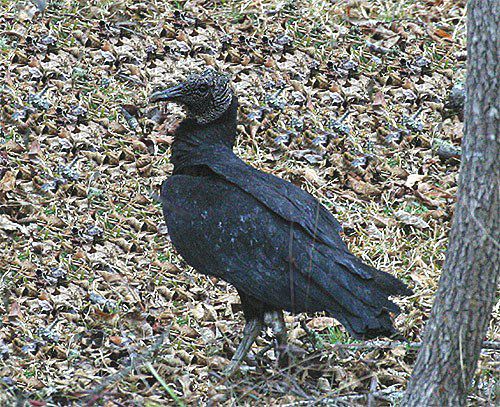
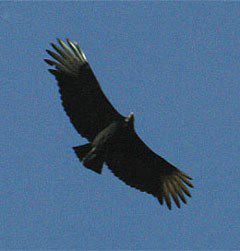
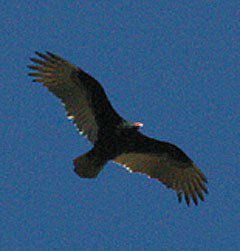
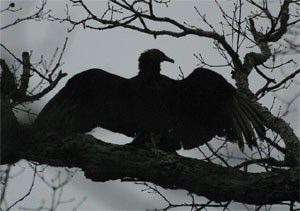
All text, maps, charts & photos © Hilton Pond Center Although many folks confuse these two vulture species, they're pretty easy to distinguish. A carrion's-eye view reveals that Black Vultures (above left) have whitish primary feathers (wingtips); the Turkey Vulture shows a gray trailing edge to its entire wing (above right). These light-colored areas are especially noticeable as either species banks in the sunlight. Turkey Vultures also have longer, rounded tails; in fact, the tail of a Black Vulture is so short the bird sometimes looks like a flying wing. The head of a Black Vulture, Coragyps atratus (top photo), remains dark throughout its life, while young Turkey Vultures, Cathartes aura, have gray heads that turn bright red (i.e., Wild Turkey-like) as they mature (below right). In the past 15 years or so, Black Vultures have expanded their range so far north that it's no longer rare to see them in fall migration over such spots as Hawk Mountain Sanctuary in Eastern Pennsylvania--a far piece from Mexico City where they roam the streets year-round just like urban pigeons in Boston or New York. Historically, Turkey Vultures have been more widely distributed across the continental U.S. and into southern Canada--as well as southward into temperate South America; their northern- and southern-most populations tend to move closer to the equator during cold weather.
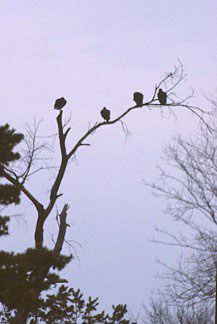
It's possible to trap vultures using dead animals as bait, but at Hilton Pond Center we don't bother because it's not permissible to band them. Vultures tend to urinate on their own legs--a behavior that may help cool them in hot weather, or that may kill bacteria that invariably collect as the birds hop around in their decomposing food items. Thus, uric acid deposits would accumulate around the bands and cause problems, so vulture biologists are obligated to use wing tags rather than bands. Both species of Piedmont vultures have keen vision, but John James Audubon was first to demonstrate that Turkey Vultures primarily use olfaction to locate prey; their sense of smell is so acute they can home in on a dead squirrel beneath leaves on the forest floor over which they are soaring. Vulture courtship is underway here in the Carolina Piedmont, and as early as February some pairs may be sharing incubation of their two-egg clutches that take 40 days or so to hatch; chicks are fed a slurry of regurgitated food and fledge about 70 days. Hard to believe as it may seem, New World Vultures are cavity-nesters, and it takes a pretty large hole to accommodate them. Sometimes they nest in rotten tree stumps, in shallow caves or on cliff ledges, or even on the floor of abandoned barns and old houses. Complete lack of nest sanitation sometimes makes it possible for a field naturalist with a strong stomach to find the nest by smell--an odor accentuated when adult and/or nestling vultures defend their territory by throwing up on the trespasser. Here at Hilton Pond Center, both vulture species have taken to day-roosting in the tallest White and Southern Red Oak trees just outside our office window. From these high perches, a half-dozen vultures may sit and preen, spreading wings to dry after a mid-winter rain (above right) and perhaps awaiting the odor of offal when another 'possum bites the dust on a nearby roadside. Then, if the wind is just right, they noisily flap their great wings (below) and grab the nearest thermal as off they go to work as nature's sanitation engineers. The Black Vulture in the top photo has managed over the past week to consume most of a monstrous four-foot Grass Carp washed up on the bank of Hilton Pond, so we're grateful these carrion-eaters still frequent local skies--especially since a dead fish and warm spring weather-to-come would make a very unpleasant combination for human nostrils. 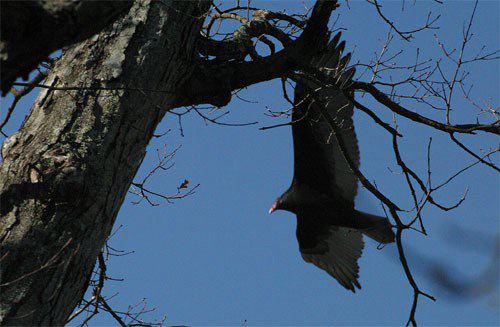
All text, maps, charts & photos © Hilton Pond Center 
Checks can be sent to Hilton Pond Center at: All contributions are tax-deductible on your |
"This Week at Hilton Pond" is written and photographed by Bill Hilton Jr., executive director of Hilton Pond Center for Piedmont Natural History |
|
Please refer "This Week at Hilton Pond" to others by clicking on this button: |
 Comments or questions about this week's installment? Send an E-mail to INFO. (Be sure to scroll down for a tally of birds banded/recaptured during the period, plus other nature notes.) |
Click on image at right for live Web cam of Hilton Pond,
plus daily weather summary
Transmission of weather data from Hilton Pond Center via WeatherSnoop for Mac.
--SEARCH OUR SITE--
For your very own on-line subscription to "This Week at Hilton Pond," |
Thanks to the following fine folks for recent gifts in support of Hilton Pond Center for Piedmont Natural History and/or Operation RubyThroat: The Hummingbird Project. Your tax-deductible contributions allow us, among other things, to continue writing, photographing, and sharing "This Week at Hilton Pond" with students, teachers, and the general public. Please see Support or scroll below if you'd like to make a gift of your own. We're pleased folks are thinking about the work of the Center and making donations. Those listed below made contributions received during the period. Please join them if you can in coming weeks. Gifts can be made via PayPal (funding@hiltonpond.org); credit card via Network for Good (see link below); or personal check (c/o Hilton Pond Center, 1432 DeVinney Road, York SC 29745). NOTE: Operation RubyThroat alumni who contributed to the 2015 Ujarrás expedition will be acknowledged in the upcoming write-up about that trip.
|
If you enjoy "This Week at Hilton Pond," please help support Hilton Pond Center for Piedmont Natural History. It's painless, and YOU can make a difference! (Just CLICK on a logo below or send a check if you like; see Support for address.) |
|
Make credit card donations on-line via Network for Good: |
 |
Use your PayPal account to make direct donations: |
|
If you like shopping on-line please become a member of iGive, through which 1,700+ on-line stores from Amazon to Lands' End and even iTunes donate a percentage of your purchase price to support Hilton Pond Center.  Every new member who registers with iGive and makes a purchase through them earns an ADDITIONAL $5 for the Center. You can even do Web searches through iGive and earn a penny per search--sometimes TWO--for the cause! Please enroll by going to the iGive Web site. It's a painless, important way for YOU to support our on-going work in conservation, education, and research. Add the iGive Toolbar to your browser and register Operation RubyThroat as your preferred charity to make it even easier to help Hilton Pond Center when you shop. Every new member who registers with iGive and makes a purchase through them earns an ADDITIONAL $5 for the Center. You can even do Web searches through iGive and earn a penny per search--sometimes TWO--for the cause! Please enroll by going to the iGive Web site. It's a painless, important way for YOU to support our on-going work in conservation, education, and research. Add the iGive Toolbar to your browser and register Operation RubyThroat as your preferred charity to make it even easier to help Hilton Pond Center when you shop. |
|
|
|
SPECIES BANDED THIS WEEK * = New species for 2003
NOTABLE RECAPTURES Dark-eyed Junco (2) Eastern Towhee (3) Northern Cardinal (7) White-throated Sparrow (3) Carolina Wren (1) Red-bellied Woodpecker (1) |
WEEKLY BANDING TOTAL YEARLY BANDING TOTAL (2003) 14 species 291 individuals BANDING GRAND TOTAL (since 28 June 1982) 123 species 42,405 individuals SIGHTINGS OF INTEREST --A pair of Canada Geese has joined the two pairs of Wood Ducks have been displaying all week on Hilton Pond. --The winter storm that deposited two feet of snow in Washington and points north left about an inch of sleet at the Center on 16-17 Feb, enough to cover the ground and bring birds scurrying back to the feeders. --In all, we received 0.7" of liquid precipitation at the Center this week, bringing Hilton Pond to within an inch of being full. VAGRANT HUMMINGBIRDS None banded this week. All text & photos © Hilton Pond Center |
|
Up to Top of Page Current Weather Conditions at Hilton Pond Center |
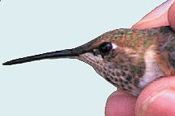
(immature male Rufous Hummingbird at right) |
|
 .
.
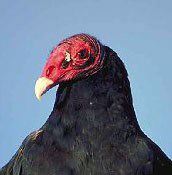 In silhouette, the nape of the Black Vulture's neck appears feathered, while that of a Turkey Vulture is naked, but both birds can pull their heads in partway, preventing heat loss from bare skin. Neither of these two vultures is completely black; in fact, some Turkey Vultures appear almost brown from above. Sexes look alike in both species.
 Usually, our New World Vultures (Cathartidae) are grouped in field guides with other soaring birds such as hawks, falcons, and eagles, but modern DNA analysis indicates they're much more closely related to another group of naked-headed birds--the storks. Furthermore, unlike diurnal raptors, vultures have relatively weak bills that are not heavily hooked, and their blunt-clawed feet are definitely non-raptorial. Despite their preference for dead things, both our vulture species have been known to take live prey; Black Vultures in particular sometimes kill newborn calves and lambs, develop a taste for hatchlings in egret and heron rookeries, or even run down live skunks.
 In a curious symbiotic relationship, the keen-nosed Turkey Vulture sometimes finds a prey item and descends on it to dine, only to be followed by olfaction-deprived Black Vultures that have been watching attentively from above. The more aggressive interlopers often displace their host and tear into the carrion, leaving only bone and sinew as a reward for the Turkey Vulture's diligent scouting work.



 Oct 15 to Mar 15: