|
|
|||
|
|
|||
THIS WEEK at HILTON POND Installment #170---Visitor # Subscribe for free to our award-winning nature newsletter (Back to Preceding Week; on to Next Week) |
|
THE "EYES" HAVE IT One satisfying thing about banding birds is that the technique provides a much closer view of our avian subjects than is offered the typical birdwatcher. Birds are amazing enough through binoculars or spotting scope, but in the hand our fascination with avian creatures increases exponentially. Up close, the intricate structure of feathers is revealed, seldom-observed attributes such as brood patches can be seen, and even tiny ticks and other parasites provide greater understanding of environmental factors birds encounter on a day-to-day basis. All these are indeed wondrous things to behold, but to us one of the most curious aspects of birds up-close is the differences in their eyes. 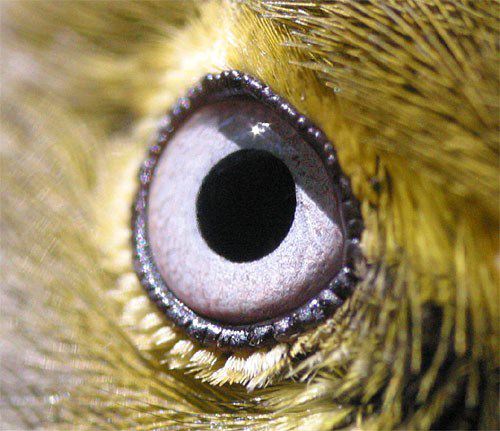
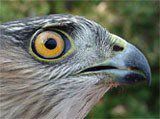
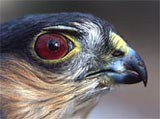
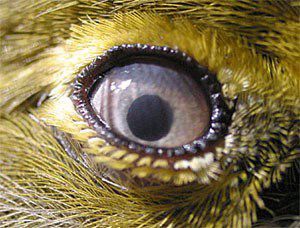
All text & photos © Hilton Pond Center Some birds--including the White-eyed Vireo (above) and the Red-eyed Vireo (below)--are even named for their easily viewed eye colors, but with the help of a hand lens we see far more detail in these birds' eyes than is otherwise possible. Exceedingly uncommon in the bird world are the ghost-like eyes of the White-eyed Vireo (WEVI); a magnified view shows the iris appears to contain white granular material and that the outer edge is laden with pink blood vessels. This is very different from the iris of the Red-eyed Vireo (REVI), laden with red pigment. Curiously, young WEVIs actually start out with muddy, gray irises that gradually become crystal-clear and white. Juvenile REVIs have irises that are brownish and muddy. The REVI below is a second-year bird hatched in 2002 and banded this week; its eye likely will darken, redden, and clarify further over the coming months. 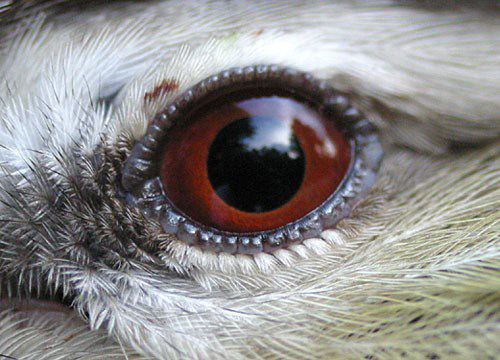 Indeed, most young birds have irises that are different in hue and clarity than adults of the same species--a phenomenon nicely illustrated in a series of Sharp-shinned Hawk photos (below). Although these are three different birds, they show the gradual shift from light to dark that is typical of some bird species. (A similar change from yellow-orange to red occurs in Eastern Towhees, although some individuals we've retrapped in successive years never demonstrate the phenomenon. In some coastal and southern populations, the iris is white in adult towhees.) We suspect the change in iris color over time provides evidence of a bird's age--important, for example, when a mature female's reproductive potential is enhanced by her selection of an older and therefore healthier and more "worldly wise" father for her offspring.
A bird's iris includes millions of pigment cells. These, in turn, contain a variety of compounds--especially melanin--and other substances such as colored oils and guanine. All these substances work in combination through reflection, refraction, and scattering to give each bird its unique eye color. In albino birds, pigment cells lack pigments entirely and the underlying blood vessels make the iris appear pink. In some bird species, eye color also may be determined by hormonal changes--as when the iris of a Brown Pelican becomes powdery blue during the breeding season. 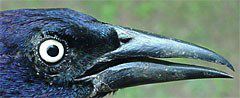 ..... .....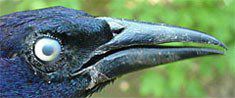 A bird in the hand reveals another eye-related structure that is nicely adaptive for the avian lifestyle. Like most vertebrates, birds have eyelids that close over the eye--blocking out light when it's time to snooze, or protecting the delicate organ from abrasion and impact. But birds have another protective device--the nictitating membrane--that is seldom noticed. This transparent "third eyelid" rests at the anterior edge of the eyeball and can sweep backward (see Common Grackle above), cleansing and temporarily covering the eye while still allowing a view--albeit milky--of the bird's surroundings. (By the way, the human eye also has a nictitating membrane--it's part of that little pink thing in the corner of your eye nearest your nose. Ours is vestigial and no longer functions as it does among the Aves.) In birds the nictitating membrane is especially useful because these winged organisms typically spend lots of time flying. In the air, even momentary loss of vision caused by closed eyelids might throw a bird off balance, causing it to plummet earthward. As typical birds, White-eyed Vireos have nictitating membranes, and a comparison of the top photo and the one at right shows just how different the bird's view of the world must be when--as is shown here--the membrane has nearly finished sweeping back to cover the eye. All birds have round pupils, except for the Rhyncopidae, which includes the Black Skimmer found in coastal regions; this family has pupils that are cat-like and become narrow vertical slits in bright light. Regardless of the species, it's really hard to see the white of a bird's eye because pupil and iris essentially fill the exposed portion of the avian eyeball.
The bird's eye is undeniably one of the most interesting structures visible to bird banders here at Hilton Pond Center, including when we handle Eastern Bluebirds (adult male below). Thus, we're sure you'll understand why we say that within the Aves, the "eyes" have it. 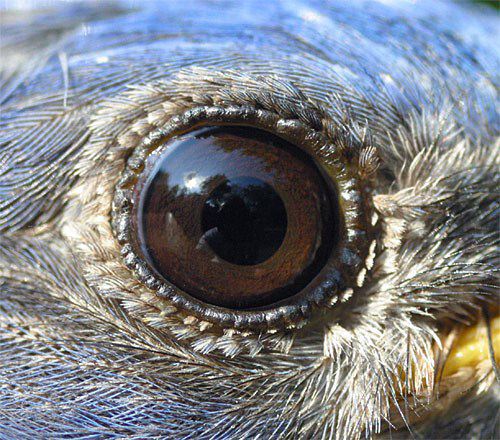
All text, maps, charts & photos © Hilton Pond Center
Checks can be sent to Hilton Pond Center at: All contributions are tax-deductible on your If you enjoy "This Week at Hilton Pond," please help Support Hilton Pond Center for Piedmont Natural History. It's painless, and YOU can make a difference! You may wish to consult our Index of all nature topics covered since February 2000. |
||||||||||
"This Week at Hilton Pond" is written and photographed by Bill Hilton Jr., executive director of Hilton Pond Center for Piedmont Natural History |
|
Please refer "This Week at Hilton Pond" to others by clicking on this button: |
 Comments or questions about this week's installment? Send an E-mail to INFO. (Be sure to scroll down for a tally of birds banded/recaptured during the period, plus other nature notes.) |
Click on image at right for live Web cam of Hilton Pond,
plus daily weather summary
Transmission of weather data from Hilton Pond Center via WeatherSnoopfor Mac.
--SEARCH OUR SITE--
For your very own on-line subscription to "This Week at Hilton Pond," |
Thanks to the following fine folks for recent gifts in support of Hilton Pond Center for Piedmont Natural History and/or Operation RubyThroat: The Hummingbird Project. Your tax-deductible contributions allow us, among other things, to continue writing, photographing, and sharing "This Week at Hilton Pond" with students, teachers, and the general public. Please see Support or scroll below if you'd like to make a gift of your own. We're pleased folks are thinking about the work of the Center and making donations. Those listed below made contributions received during the period. Please join them if you can in coming weeks. Gifts can be made via PayPal (funding@hiltonpond.org); credit card via Network for Good (see link below); or personal check (c/o Hilton Pond Center, 1432 DeVinney Road, York SC 29745). |
If you enjoy "This Week at Hilton Pond," please help support Hilton Pond Center for Piedmont Natural History. It's painless, and YOU can make a difference! (Just CLICK on a logo below or send a check if you like; see Support for address.) |
|
Make credit card donations on-line via Network for Good: |
 |
Use your PayPal account to make direct donations: |
|
If you like shopping on-line please become a member of iGive, through which 1,500+ on-line stores from Amazon to Lands' End and even iTunes donate a percentage of your purchase price to support Hilton Pond Center.  Every new member who registers with iGive and makes a purchase through them earns an ADDITIONAL $5 for the Center. You can even do Web searches through iGive and earn a penny per search--sometimes TWO--for the cause! Please enroll by going to the iGive Web site. It's a painless, important way for YOU to support our on-going work in conservation, education, and research. Add the iGive Toolbar to your browser and register Operation RubyThroat as your preferred charity to make it even easier to help Hilton Pond Center when you shop. Every new member who registers with iGive and makes a purchase through them earns an ADDITIONAL $5 for the Center. You can even do Web searches through iGive and earn a penny per search--sometimes TWO--for the cause! Please enroll by going to the iGive Web site. It's a painless, important way for YOU to support our on-going work in conservation, education, and research. Add the iGive Toolbar to your browser and register Operation RubyThroat as your preferred charity to make it even easier to help Hilton Pond Center when you shop. |
|
|
SPECIES BANDED THIS WEEK * = New species for 2003 WEEKLY BANDING TOTAL 13 species 24 individuals YEARLY BANDING TOTAL (2003) 27 species 497 individuals BANDING GRAND TOTAL (since 28 June 1982) 123 species 42,611 individuals NOTABLE RECAPTURES THIS WEEK (with original banding date, sex, and current age) Carolina Chickadee (1) 03/29/02--after 2nd year male Northern Cardinal (6) 08/08/95--9th year female 01/17/99--after 5th year female 04/22/02--after 2nd year male 07/29/02--2nd year male 07/29/02--2nd year female 08/05/02--2nd year male White-throated Sparrow (3) 11/06/01--3rd year unknown 11/19/01--3rd year unknown 11/21/01--3rd year unknown Tufted Titmouse (4) 07/30/01--3rd year female 04/18/02--after 2nd year male 06/11/02--2nd year female 06/17/02--2nd year male Brown Thrasher (1) 09/12/02--after 2nd year male |
OTHER SIGHTINGS OF INTEREST 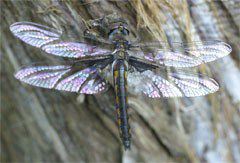 --A Common Baskettail, Epitheca cynosura (above), seen on 28 Apr became the ninth identified dragonfly species at Hilton Pond Center. During the week we also spent a good deal of time safely removing several large Swamp Darter dragonflies, Epiaeschna heros, from mist nets intended to catch birds. --A Common Snapping Turtle trolling the surface of Hilton Pond on 30 Apr was highly visible because of a layer of yellow clay caked on its shell.
All text & photos © Hilton Pond Center
|
|
(Back to Preceding Week; on to Next Week) Back to "This Week at Hilton Pond" Main Current Weather Conditions at Hilton Pond Center The Center's backyard Web cam at Weather Underground |
|

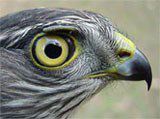
 And isn't it great that birds such as falcons--which intentionally dive at high rates of speed--can protect their eyes from the rushing wind simply by closing their nictitating membranes, or that loons and ducks have a clear central lens in the membrane that allows them an undistorted view when swimming underwater?
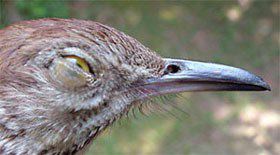 Curiously, some birds such as Brown Thrashers apparently can "see" even when their eyes are closed, since the eyelid itself is unfeathered, thin, and semi-transparent (left). The thrasher also demonstrates that in birds the bottom eyelid moves upward--opposite of the way the lids work in humans. The various close-up images on this page likewise reveal that just as humans have modified hairs that line the eyelids and filter out dust, birds have short, bristly feathers that serve the same function.




 Please report your