|
|
|||
|
|
|||
(Installment #185)
(Back to Preceding Week; on to Next Week)
|
SPINY-BACK SPIDERS Long ago before we knew any better, we patrolled summer woods with a large stick, waving it to and fro to clear our path of spider webs. Nothing's worse than getting a mouthful of sticky silk--or getting some plastered against your glasses lens--and we figured the best way to deal with webs was to eradicate them. Fortunately, we got enlightenment-- well before the time we began imitating spiders by erecting mist nets to catch wild birds for banding--and more recently have preached the value of not destroying webs. These days we encourage visitors to Hilton Pond Center to step over, around, or under each spider web, and to take time to examine the fascinating creatures that spin their silken traps across our trails. 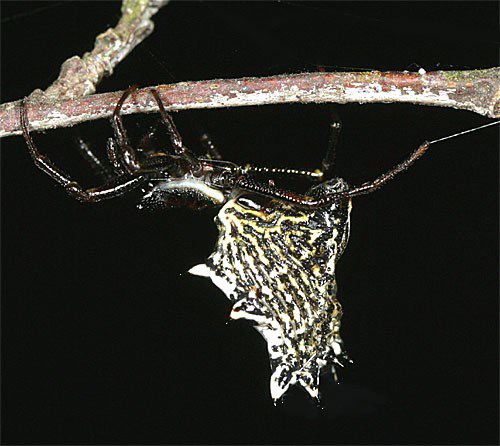
All text & photos © Hilton Pond Center At the Center such avoidance behavior means slow going during the dog days of August. Every few paces on every trail there's another web impeding our progress, and getting past some of them with out damage to web or lumbar vertebrae requires a bit of physical agility. The majority of trail-blocking webs are three-sided, with a tightly woven spiral of sticky silk attached within the triangle. Most often there is a long horizontal line at the top that connects two trees on either side of the trail. From one end of this topline another strand of silk angles downward--sometimes anchored to the ground, sometimes to the base of one of the vertical trees. Even though webs slow our trail- walking, it makes sense they would go across a path rather than paralleling it; insects that comprise the spider's food are more likely to fly down an open pathway than into trees on either side. If we manage to spot a web on the trail before running into it, there's usually a spider sitting near its center. Around Hilton Pond the largest but least common of these are Black and Yellow Argiopes--big black and yellow eight-leggers that are sometime called "writing spiders" because of a white zigzag they weave into their webs. Slightly more numerous are several sizes of brown orb-weavers we haven't yet learned to identify. But by far the most prevalent spiders blocking our trails are those with spiny abdomens: the Micrathena group. Micrathena spiders occur across the U.S. and Canada and into the American tropics. The females are characterized by spines or bumps on their abdomens that give them an angular appearance. These projections--quite sharp in some species--once drew our blood when a spiny-back spider dropped onto our neck. Thinking it was a Deer Fly, we slapped it hard and drove the points through the skin on our neck AND our hand. This was painful to us, but the spider just bounced off and went on its merry way. Although these sharp spines are most certainly not an adaptation to prevent people from hitting at the spider, they probably do keep some predators from eating it. We can only imagine how it might feel to squeeze a Micrathena spider between the tongue and soft palate. 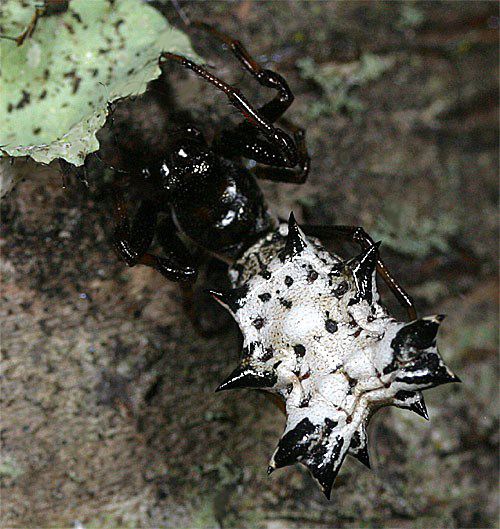
All text & photos © Hilton Pond Center The Micrathena we see most often around Hilton Pond is M. gracilis, whose common name is the not-very-imaginative "Spined Micrathena." This species is widely distributed across the eastern U.S. in open woods that are early into succession. The female has a total length of nearly half an inch--at least half of which is a whitish or yellowish ten-spined abdomen with light and dark striations on the sides (top photo) and white blotches on the dorsal portion (above). Compared to his mate, a male M. gracilis (above right) is much smaller at only about a quarter-inch long. He also sports no spines, has a flat and elongated brown abdomen, and is seldom seen. He spends much of his time hiding in or near a female's web, waiting for just the right time to move in to copulate without getting eaten in the process. The web of a female Micrathena gracilis is a small, delicate orb about 6-8" inches across--just the size for catching small insects such as flies and mini-moths. She weaves the web by exuding silk from her abdomen, using her hind feet to guide the strands into a tight spiral with non-sticky support spokes. This ability is one of the most wondrous events in nature, and we're glad we now have enough sense to avoid webs and observe the spiny-back spiders that toil and spin at Hilton Pond Center. All text & photos © Hilton Pond Center ADDENDUM: Below is a photo of yet another spiny-back spider, this time a female White Micrathena, Micrathena mitrata. This species is somewhat smaller than M. gracilis.
All text & photos © Hilton Pond Center Comments or questions about this week's installment?
Thanks to the following fine folks for recent gifts in support of Hilton Pond Center for Piedmont Natural History and/or Operation RubyThroat: The Hummingbird Project. Your tax-deductible contributions allow us to continue writing, photographing, and sharing "This Week at Hilton Pond." (Please see Support if you'd like to make a gift of your own. You can also contribute by ordering an Operation RubyThroat T-shirt.)
"This Week at Hilton Pond" is written & photographed You may wish to consult our Index of all nature topics covered since February 2000. You can also use our on-line Hilton Pond Search Engine at the bottom of this page. For a free, non-fattening, on-line subscription to |
|
Make direct donations on-line via
Network for Good: |
 |
|
Use your PayPal account
to make direct donations: |
|
 If you like to shop on-line, you please become a member of iGive, through which more than 750 on-line stores from Barnes & Noble to Lands' End will donate a percentage of your purchase price in support of Hilton Pond Center and Operation RubyThroat. For every new member who signs up and makes an on-line purchase iGive will donate an ADDITIONAL $5 to the Center. Please sign up by going to the iGive Web site; more than 200 members have signed up to help. It's a painless, important way for YOU to support our on-going work in conservation, education, and research. |
|
|
|
|
SPECIES BANDED THIS WEEK: * = New species for 2003 WEEKLY BANDING TOTAL 5 species 15 individuals
YEARLY BANDING TOTAL (2003) 46 species 782 individuals
BANDING GRAND TOTAL (since 28 June 1982) 123 species 42,896 individuals
NOTABLE RECAPTURES THIS WEEK (with original banding date, sex, and current age) Ruby-throated Hummingbird (3)
VAGRANT HUMMINGBIRDS None this week. This Week at Hilton Pond |
OTHER SIGHTINGS OF INTEREST 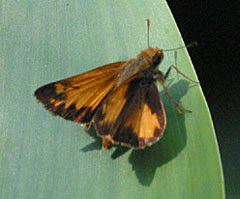 Zabulon Skipper (male) Zabulon Skipper (male)Poanes zabulon --Pickerelweed, Pontederia cordata, which grows profusely in a small water garden at Hilton Pond Center, continues to attract Ruby-throated Hummingbirds, bumblebees, and several varieties of butterflies, including small skippers (above). --We held our last scheduled Hummingbird Mornings presentations of the summer on 16 Aug at McDowell Nature Preserve just southwest of Charlotte NC. Sponsored by Chirp N' Chatter backyard nature store, the two sessions--despite a tremendous early morning downpour--were attended by more than a hundred people, bringing our 2003 attendance total to nearly 1,600 hummingbird enthusiasts! We've already booked three of the six possible Hummingbird Mornings weekends in July-September 2004; if your group is interested in hosting a weekend next summer, please send an e-mail to Education. |
|
|
|
(Back to Preceding Week; on to Next Week) Up to Top of Page Back to This Week at Hilton Pond Center Current Weather Conditions at Hilton Pond Center |
 You can also post questions for The Piedmont Naturalist |
Join the |
Search Engine for |
|
|

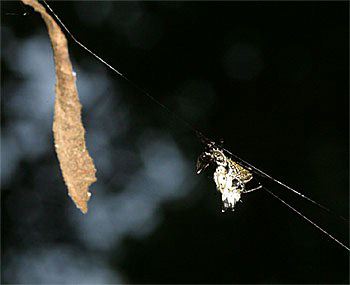 The third line connects the other two. A dry, non-sticky escape line, which allows the spider to evacuate quickly in crisis situations, often leads from the top of the web to an overhanging branch or leaf (right).
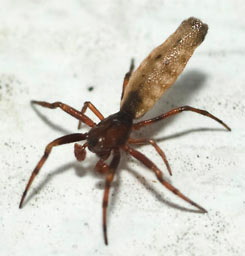 Her abdomen is further ornamented by nearly microscopic dimples that apparently have no known function. The smooth-surfaced carapace--to which eight glossy black legs are attached--is dark brown or amber-colored, and the head bears several pairs of tiny eyes remarkably sensitive to light and movement. (NOTE: The female in the photo above had just vacated her web via an escape line to take refuge under a foliose lichen growing on the support tree.)
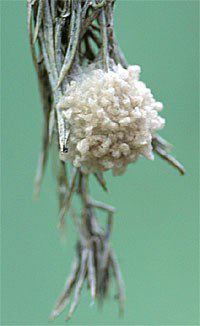 After mating, the female creates a tan sphere that is soft and knobby and lays her eggs within (below left); this silken case, affixed to vegetation near the web, protects the eggs from desiccation and predators.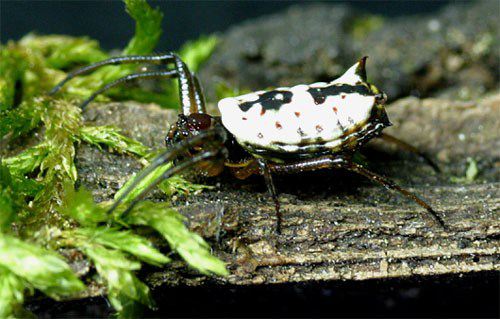
 Be sure to scroll down for an account of all
 Please report your sightings of
 Hilton Pond Center for Piedmont Natural History is a non-profit research & education organization in York, South Carolina USA; phone (803) 684-5852. Directed by