|
|
|||

|
THIS WEEK at HILTON POND
Installment #127---Visitor #
Back to Preceding Week; on to Next Week |
|
BLACK, BRISTLY CATERPILLAR Humans and butterflies are adapted best for diurnal activity, so it's not surprising from spring through fall we often encounter butterflies on daytime excursions. Most folks can identify at least a few butterfly species and even install plants that attract these colorful insects to their yards. The majority of moths, on the other hand, are poorly known, primarily because they fly at night and are seldom seen--except for those that flutter around our porch lights or get into the woolens. 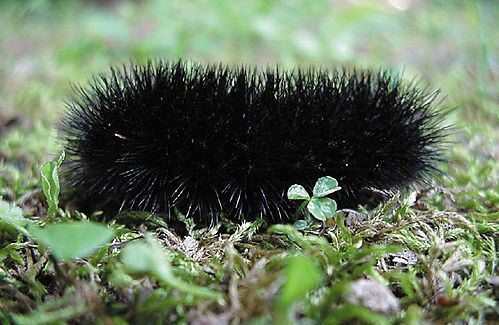
All text & photos © Hilton Pond Center Here at Hilton Pond Center we're nearly as likely to see moth caterpillars as the moths themselves, especially since these voracious larvae are moving and eating almost around the clock. Lately we've made a concerted effort seek out, watch, and identify lepidopteran larval stages--all in the name of gaining better understanding of our local moth population. This week, for example, we discovered a 2" inch caterpillar (above) stretched out under a couple of loose boards. The larva resembled one of those familiar brown-and-black Woolly Bears that supposedly forecast the severity of winter weather, but it was completely covered with quarter-inch black bristles that shined in the sun like patent leather. As a rule, it's best not to handle hairy caterpillars because some of them are poisonous. When specialized hollow hairs on these caterpillars are touched by us "thin-skinned" humans, one or more may break off, create a tiny scratch on our hand, and release a strong toxin into the nearly invisible wound. This process--called "urtication"--is analogous to a bee sting, except that the poison is trasmitted by a scratch rather than an injection. Caterpillar urtications can cause severe allergic responses and even death in some people, so--as we said--better NOT to handle hairy caterpillars unless you know they are harmless varieties. With this precaution in mine, we carefully scooped our new-found black caterpillar onto a piece of wood, This particular field guide groups caterpillars according to their skin characteristics, e.g., smooth, smooth with knobs or bumps, hairy, bristled, with branched spines, etc., so we turned to the "bristled" section. The first entry was the Woolly Bear, and on the very next page we found a painting of a black, bristly caterpillar with red bands between its segments. The large-ish Giant Leopard Moth has a 3" wingspan and is distinctively marked, with black circles on its otherwise pure white wings (below left); the abdomen, hidden by its wings when the moth is at rest, is metallic blue with bright orange markings. Found across the eastern U.S., Giant Leopard Moths are especially common in the south central and southeastern states. From early summer through fall, adult moths--or at least the males--often come at night to electric lamps; some lepidopterists report that females of this species may not be attracted to lights.
The Giant Leopard Moth caterpillar spends the winter in a state of hibernation, although in more temperate parts of its range it may wake temporarily on mild days for a mid-winter snack. When spring arrives, Giant Leopard Moth caterpillars become active again and feed heavily until optimal size is reached, at which time each larva shucks off its spiny exoskeleton one more time and makes a pupa (below right). 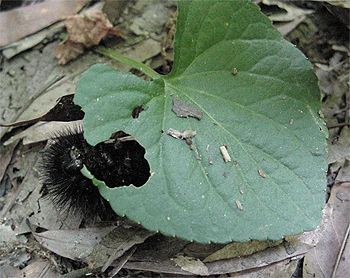 Thanks to Rusty Trump of Suwanee, Georgia for his photos of the adult Giant Leopard Moth and the pupa from which it came. Comments or questions about this week's installment?
If you enjoy "This Week at Hilton Pond," please help Support Hilton Pond Center for Piedmont Natural History. It's painless, and YOU can make a difference! "This Week at Hilton Pond" is written & photographed You may wish to consult our Index of all nature topics covered since February 2000. You can also use our on-line Hilton Pond Search Engine at the bottom of this page. For a free, non-fattening, on-line subscription to |
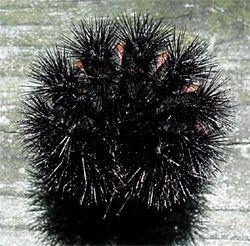 where it immediately curled up into a ball and revealed what we suspected would be a useful field mark: bright red bands between its body segments (left). After we made our way back to the library at Hilton Pond Center, we took down one of the few caterpillar field guides in print (Peterson First Guide to Caterpillars by Amy Bartlett Wright; Houghton Mifflin Company, 1993) and searched for an illustration that matched.
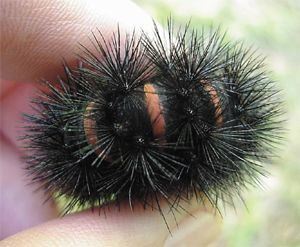 There wasn't much question about the identification: Giant Leopard Moth, Hypercompe scribonia (formerly Ecpantheria scribonia), a non-poisonous species that we now felt comfortable handling so we could see the red bands and bristles even better (right).
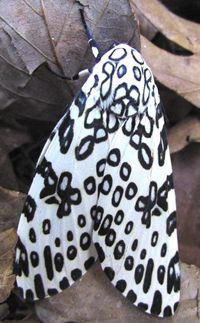 Like many moths, the female Giant Leopard Moth produces pheromones from a gland at the tip of her abdomen. These potent chemicals carry on the wind and are detected by antennae on the male, who follows the scent to his prospective mate. After copulation, the female lays her eggs on a wide variety of host plants--including violets, plantains, dandelion, cherries, maples, and willows whose leaves are eaten by her larvae--and probably dies soon thereafter, while the male my seek another mate. Fertile eggs develop and hatch within days, after which the larvae dine on leaves of their respective host plants and go through several growth stages in which they must molt their restrictive outer skins. To our knowledge, adult Giant Leopard Moths do not eat and spend their short lives reproducing.
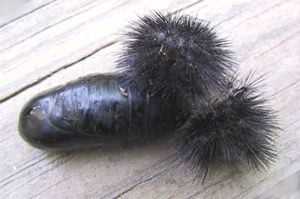 The adult metamorphoses therein and emerges after only a few weeks; thus, the cycle begins again for the Giant Leopard Moth--whose larvae we encourage at Hilton Pond Center because they are known to dine on Japanese Honeysuckle. The caterpillar we found and photographed will need to change its diet, however, because we do all we can to eliminate invasive honeysuckle vines. Fortunately, soon after we let it go the black, fuzzy caterpillar crawled into a patch of wildflowers and chowed down hungrily on the underside of a heart-shaped Blue Violet leaf (below).
 Be sure to scroll down for an account of all
If you enjoy "This Week at Hilton Pond," please help support Hilton Pond Center for Piedmont Natural History. It's painless, and YOU can make a difference! (Just CLICK on a logo below or send a check if you like; see Support for address.) |
|
Make credit card donations on-line via Network for Good: |
 |
Use your PayPal account to make direct donations: |
|
If you like shopping on-line please become a member of iGive, through which 1,800+ on-line stores from Amazon to Lands' End and even iTunes donate a percentage of your purchase price to support Hilton Pond Center.  Every new member who registers with iGive and makes a purchase through them earns an ADDITIONAL $5 for the Center. You can even do Web searches through iGive and earn a penny per search--sometimes TWO--for the cause! Please enroll by going to the iGive Web site. It's a painless, important way for YOU to support our on-going work in conservation, education, and research. Add the iGive Toolbar to your browser and register Operation RubyThroat as your preferred charity to make it even easier to help Hilton Pond Center when you shop. Every new member who registers with iGive and makes a purchase through them earns an ADDITIONAL $5 for the Center. You can even do Web searches through iGive and earn a penny per search--sometimes TWO--for the cause! Please enroll by going to the iGive Web site. It's a painless, important way for YOU to support our on-going work in conservation, education, and research. Add the iGive Toolbar to your browser and register Operation RubyThroat as your preferred charity to make it even easier to help Hilton Pond Center when you shop. |
|
|




 Hilton Pond Center for Piedmont Natural History is a non-profit research & education organization in York, South Carolina USA; phone (803) 684-5852. Directed by