HOME: www.hiltonpond.org |
|||

HILTON POND
(Page updated 08/24/23)
|
Hilton Pond Center for Piedmont Natural History is a 501(c)(3) non-profit education and research organization based in York, South Carolina USA. |
|
The integrated Mission of |
Hilton Pond Center for Piedmont Natural History has been in operation as a conservation, educational, and scientific research site for 41 years. It was established on an old Piedmont farmstead in 1982 and has been a field trip destination for school groups, college classes, environmental organizations, professional scientists, and others interested in conservation and nature. 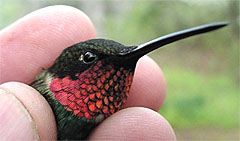 Since 28 June 1982, Dr. Bill Hilton Jr. has banded 78,600-plus birds of 128 species on the 4.3 hectare (11-acre) tract, making it the most active banding station in the Carolinas and one of the most active in the entire southeastern United States. Included in those totals are 7,404 Ruby-throated Hummingbirds, Archilochus colubris (adult male above left). Because of this work, in 2003 the Center was designated an "Important Bird Area" by the National Audubon Society and BirdLife International. In all, 173 bird species have been observed on, over, or from the property. Since 28 June 1982, Dr. Bill Hilton Jr. has banded 78,600-plus birds of 128 species on the 4.3 hectare (11-acre) tract, making it the most active banding station in the Carolinas and one of the most active in the entire southeastern United States. Included in those totals are 7,404 Ruby-throated Hummingbirds, Archilochus colubris (adult male above left). Because of this work, in 2003 the Center was designated an "Important Bird Area" by the National Audubon Society and BirdLife International. In all, 173 bird species have been observed on, over, or from the property.
For an article on the history of Hilton Pond Center, please see Origins. All text & photos © Hilton Pond Center |
| This huge White Oak, Quercus alba, at Hilton Pond Center for Piedmont Natural History was the largest tree on the property but blew down in 2015; it was one of many native trees, shrubs, and wildflowers that provide food, shelter, and space for birds, small mammals, reptiles and amphibians, insects, and other wildlife. Hilton Pond Center is one of the most active bird banding stations in the Southeast and the site for several award-winning research projects by elementary and high school science students. Work done at Hilton Pond Center is especially valuable because the Piedmont physiographic province is one of most common but least-studied regions of the eastern United States. |
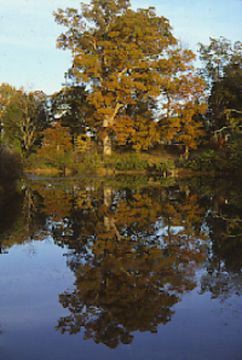 © Hilton Pond Center Hilton Pond itself covers about 1.25 acres of the 11-acre property |
|
Hilton Pond Center for Piedmont Natural History was formally incorporated in 1999 by its national Board of Trustees, with Dr. Bill Hilton Jr. serving as executive director. The Center is recognized by the State of South Carolina and the federal government as a 501(c)(3) non-profit education and research organization. As such it is eligible to receive grants and tax-deductible donations from foundations, corporations, and individuals. An award-winning science educator and nature writer, Hilton holds a Master Permit (#21558) from the federal Bird Banding Laboratory in Laurel, Maryland. He has conducted and published in-depth research on Ruby-throated Hummingbirds, House Finches (Carpodacus mexicanus), Purple Finches (C. purpureus), and Blue Jays (Cyanocitta cristata), and frequently publishes newspaper, magazine, and journal articles about natural history. In 1999, Hilton Pond Center became the southernmost site in a national network using night-time banding to study dispersal of Northern Saw-whet Owls, Aegolius acadicus. Through August 1999, only four saw-whets had ever been banded in South Carolina--the most recent in 1972. In November and December 1999 at Hilton Pond Center, Hilton netted and banded seven of these diminutive owls from the forests of Canada. Three additional November owls were captured, one each in 2000, 2001, and 2008. In 2002, the Center was designated as an education site for Schweinitz's Sunflower, Helianthus schweinitzii, a federally endangered species native to Piedmont prairies. |
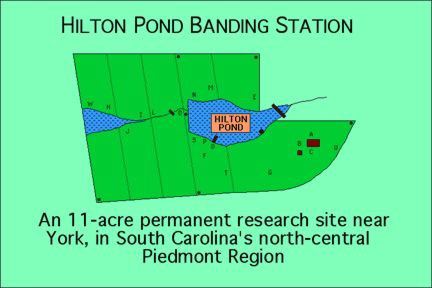
Map © Hilton Pond Center |
| Hilton Pond Center for Piedmont Natural History includes an active bird banding station. Net lanes (marked by capital letters) are established along the margins of two ponds and various kinds of traps are located around the two buildings (red rectangles). Most Ruby-throated Hummingbirds are caught in pull-string traps at locations A, B & C. |
|
Hilton Pond Center was the site for an intensive three-year research project on the "Ecology of Small Mammals of the Piedmont"--a significant study conducted by high school student Billy Hilton III, whose work received top awards at the 1994 and 1995 International Science and Engineering Fairs. Another student project on Pine Siskins, Carduelis pinus, was accepted for presentation by Kelly Dunlap at the 1985 South Carolina Junior Academy of Science research competition. A third student, Garry Hilton, had similar science fair successes at the elementary and junior high levels for research on bird abundance and avian habitat preference. Students and visitors have also helped compile comprehensive checklists and photographic records of flora and fauna that occur at Hilton Pond Center.
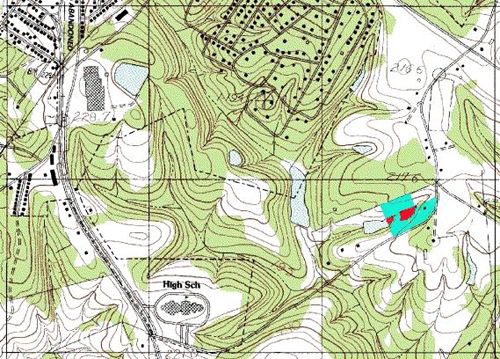
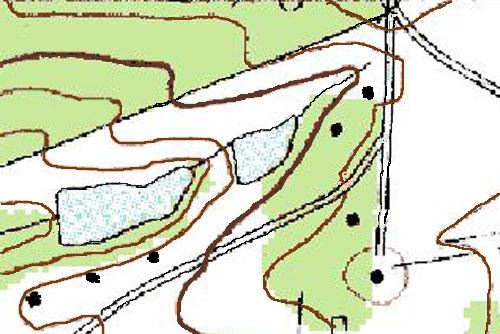
USGS Topgraphic Maps of Hilton Pond Center (above and below).
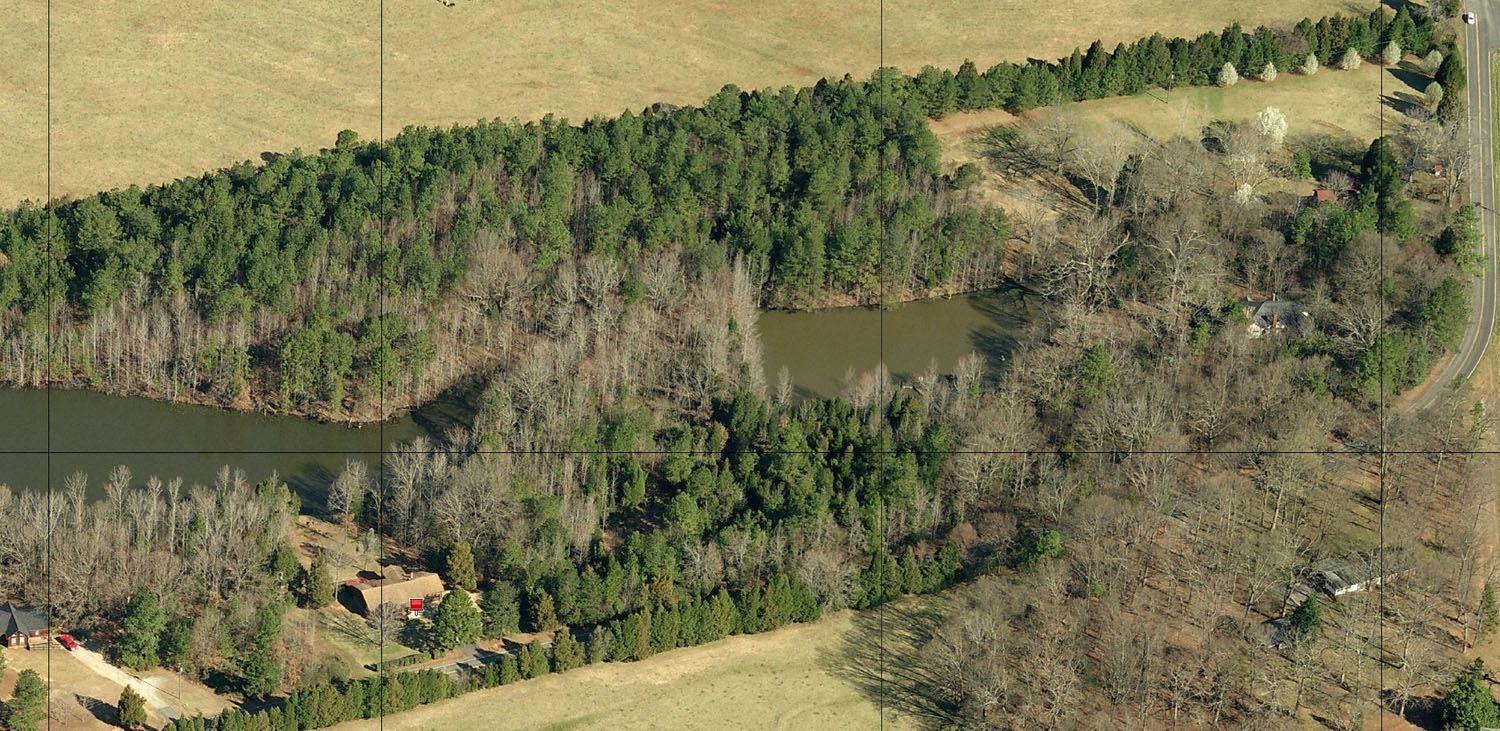
Oblique aerial photo of Hilton Pond Center in 2007 In October 1999, Hilton Pond Center unveiled Operation RubyThroat:The Hummingbird Project, a cross-disciplinary international initiative through in which students, teachers, and citizen scientists collaborate to study behavior and distribution of Ruby-throated Hummingbirds. Participants live in the United States, Canada, Mexico, and all seven countries of Central America (Belize, Costa Rica, El Salvador, Guatemala, Honduras, Nicaragua, and Panama)--all places in which this bird regularly occurs at some time during the year. Because Ruby-throated Hummingbirds typically tolerate people and are even drawn to flower gardens and hummingbird feeders we provide, they are an ideal subject for natural history observation and research by students and adults of all ages. Participants in Operation RubyThroat are linked via the Internet and World Wide Web and especially through the project's website (www.rubythroat.org), which averages more than 1,000 main page hits each week. Operation RubyThroat was implemented in stages, with the pilot year (Year One, or academic year 2001-2002) involving teachers and students in the Carolinas and New York; Research and education studies at Hilton Pond Center have been funded in part by small grants from the South Carolina Department of Natural Resources, Perky-Pet (manufacturer of hummingbird feeders), Sigma Xi Scientific Research Society of Clemson University, South Carolina Junior Academy of Science, and Filipowksi Foundation. Larger grants have come from The Christensen Fund, National Fish and Wildlife Foundation, ConocoPhillips Petroleum Migratory Bird Fund, Agilent Technologies Foundation, and Foundation for the Carolinas Impact Fund. Hilton Pond Center was honored to be one of the few small non-profits to receive a prestigious 42-month grant from the National Science Foundation in support of Operation RubyThroat. The Center welcomes in-kind and financial donations from individuals and organizations to underwrite its important research, education, and conservation activities (see Funding & Support). Work done at Hilton Pond Center is especially valuable because the Piedmont Physiographic Province is one of most common but least-studied systems of the eastern United States. (Click here for more information about the Piedmont Region.) All text & photos © Hilton Pond Center |
|
Back to Table of Contents Back to General Information Up to Top of Page |
|
Make direct donations on-line via
Network for Good: |
 |
|
Use your PayPal account
to make direct donations: |
|
|
If you like shopping on-line please become a member of iGive, through which 800+ on-line stores from Amazon to Lands' End and even iTunes donate a percentage of your purchase price to support Hilton Pond Center .
 Every new member who registers with iGive and makes a purchase earns an ADDITIONAL $5 for the Center. You can even do Web searches through iGive and earn a penny per search--sometimes TWO--for the cause! Please enroll by going to the iGive Web site. It's a painless, important way for YOU to support our on-going work in conservation, education, and research. Add the iGive Toolbar to your browser and register Operation RubyThroat as your preferred charity to make it even easier to help Hilton Pond Center when you shop. Every new member who registers with iGive and makes a purchase earns an ADDITIONAL $5 for the Center. You can even do Web searches through iGive and earn a penny per search--sometimes TWO--for the cause! Please enroll by going to the iGive Web site. It's a painless, important way for YOU to support our on-going work in conservation, education, and research. Add the iGive Toolbar to your browser and register Operation RubyThroat as your preferred charity to make it even easier to help Hilton Pond Center when you shop. |
|

 post questions for The Piedmont Naturalist |
Join the |
Search Engine for |
|
|
 Year Two (2002-2003) expanding to all 38 states within the breeding range of the Ruby-throated Hummingbird; and Year Three (2003-2004) including Canada, Mexico, and Central America. Operation RubyThroat is affiliated with The GLOBE Program (logo at right), a collaboration among NASA, NOAA, NSF, EPA, and public and private institutions worldwide (see
 Hilton Pond Center for Piedmont Natural History is a non-profit research & education organization in York, South Carolina USA; phone (803) 684-5852. Directed by